
Hello, Lewis and Clark Fuji Summer Program student. Yōkoso! You’ve made it to Japan, and made it through the first half of your program. Aren’t you excited to climb Mount Fuji?!
Most people take a bus up from the fifth station and climb up from there, but you seem like you’re in good shape. Want to climb up from the base?
The first! Like the pilgrims used to!
I’ll start from the fifth, either way I get to the top.
Can I take a train up to the top?
There actually were plans to make a railway all the way to the peak, but they were never realized. After all, the peak is sacred space and belongs to the Sengen Shrine (Bernstein, 2008). If you want to get to the peak, you’ll have to walk.
Okay, I’ll start at the first station.
I’ll start from the fifth, either way I get to the top.
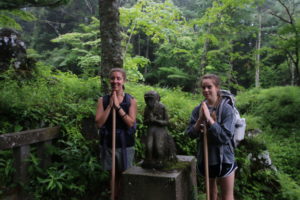
Before you climb, you might want to pick up some extra gear — rent a raincoat, buy some snacks, and pick up a traditional climbing stick from Kitaguchi Hongu Fuji Sengen Shrine. What do you think?
Absolutely, you can never be too prepared.
Nope! I’ll be fine in my trusted Nikes.
You’re a bit chilly and have spent way too much money on snacks. Luckily, it hasn’t rained. It’s getting late; do you want to stop for the night in a mountain hut?
Yes! Phew, I’ll be happy to get some sleep.
No, I just want to get to the top!
Before you climb, you might want to pick up some extra gear. Rent a raincoat, buy some snacks, and pick up a traditional climbing stick from Seven Eleven What do you think?
Absolutely, you can never be too prepared.
Nope! I’ll be fine in my trusted Nikes.
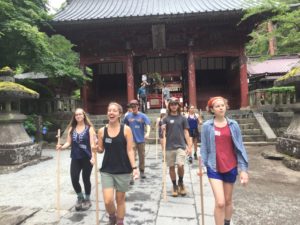
Cool! That traditional climbing staff will be a great souvenir. You can get it stamped at every station along the way! You feel a bit conflicted about this because, while it does make you feel like a pilgrim, it is a bit gimmicky. You notice that only the tourists are carrying the poles – the Japanese are using modern trekking poles, which are probably better for their knees anyway (Thomas Jones, 8/2/2017). Oh well. You’ve done all the readings for class, so you know that pilgrimage and tourism have been closely linked in Japan since the Tokugawa period, when travel was restricted to all but powerful lords and religious pilgrims (Marco Gottardo, 7/2/2017). Maybe you’ll write a blog post about this.
And because you are so excited about getting the stamps at every station, you hardly notice time pass. It’s getting late! You decide to stop for the night in a mountain hut.
Yes! Phew, I’ll be happy to get some sleep.
You weren’t expecting bottled water to be so expensive up here! Luckily, you brought plenty of cash. You’re having fun on the climb and have managed to avoid twisting your ankle as you clambered over scoria. It’s getting late. Do you want to stop for the night in a mountain hut?
Yes! Phew, I’ll be happy to get some sleep.
No, I just want to get to the top!
You keep going at breakneck speed when suddenly… Oh no! You feel horrible! Your head pounds, you’d rather be dead than on this mountain. It’s altitude sickness; you weren’t prepared and you didn’t give your body time to adjust to the elevation. The rangers have to airlift you off the mountain. This happens, every once and a while, to tourists like you who don’t listen to the park ranger’s advice (Yukimoto Shinsuke, 7/11/2017 ). Today is not your day, but maybe you’ll try climbing again– and next time you’ll be more prepared.
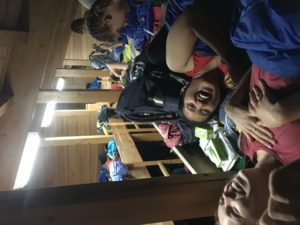
You don’t sleep a wink, but you’re glad for the rest. You get up at four to see the sunrise. You’re not at the peak, but that seems fine since you didn’t really want to stand in line for hours as you inched your way up the crowded mountain. Anyway, there were some Fujiko who wouldn’t go above the eighth station for the sunrise because then they would be looking down on the sun as it rose and that would be disrespectful to the kami.
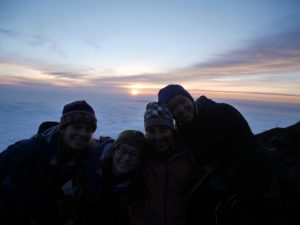
After you watch the sunrise, you take your time climbing to the summit.
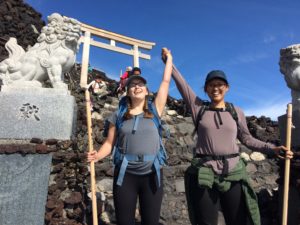
3776 meters. You did it! Congratulations!
There’s more to see, do you want to walk around the crater?
I don’t want to miss a thing, let’s go!
I’m beat, I’d rather head down the mountain now. But this has been an unforgettable experience.
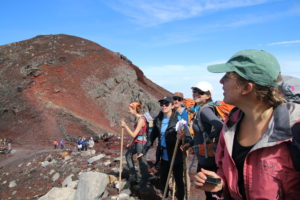
You decided to hike around the crater. You send some cards from the post office and see the weather station. You remember how, back in 1895, Chiyoko and Itaru Nonaka tried (and failed) to spend a winter on the peak to record weather observations (Bernstein, 2013) – and are struck by an overwhelming appreciation for the people who climbed before you and the work that went into creating the infrastructure which made your hike so smooth.
That was so much fun! A once in a lifetime adventure!
The climb really stirred something inside me. I’ll be back again, I’m sure.
You will return to Portland and create a Lewis & Clark confraternity in order to send more students to climb Fuji. After all, Fumio Shishino, the Chief Priest of Fusokyo, had invited the LC group to become a Fujiko. You thought it would be unusual for anyone to worship a mountain they can’t see, and you aren’t Japanese… But after experiencing the majesty of the mountain, you know it is your calling to reinvigorate the aging form of worship.
As you head down the mountain you see so many different types of people descending. The one thing you all have in common is that you all (tried) to reach the highest point to Japan. You’re not all religious pilgrims, but you all went on a pilgrimage of sorts. The climb was not the same window into Japanese history and culture for everyone. Not every climber learned about Japanese history on their journey, but every single climber learned something about themselves or about the world. On a different note, every single climber brought money into the local economy. You all engaged with this tourist landscape. Fujiko members and unprepared foreigners alike, you’re all tourists.
Work Cited:
Bernstein, Andrew. 2013. “Weathering Fuji: Marriage, Meteorology, and the Meiji Bodyscape.” In Japan at nature’s edge: the environmental context of a global power, edited by Ian Jared Miller, Julia Adney Thomas, and Brett L. Walker.
Bernstein, Andrew. 2008. “Whose Fuji?: Religion, Region, and State in the Fight for a National Symbol.” Monumenta Nipponica 63 (1): 51–99.