
“Aging population is a concern for the workforce and the local economy.” That statement was drilled into my head over and over again during my high school years in Singapore. Having the third highest life expectancy in the world (CIA, 2016) and a constantly declining birth rate, Singapore has always been extremely concerned with its rapidly aging population. Whenever this topic was brought up in a conversation, more often than not, Japan would be mentioned as an example of a aging nation struggling to find a solution for its declining workforce. With 26.3% of its population being over 65 years old, Japan has the oldest population in the world (World Atlas, 2017). During my four weeks in Japan, this is a fact that I certainly did not miss.
Despite having learned about Japan’s aging population, this reality was not immediately apparent to me when I first arrived on the lively streets of Tokyo. In fact, the uneven geographic distribution of elderly people in Japan is not reflected by the national percentage of aging population. While the vibrant, happening streets of Tokyo attracted a younger crowd, quiet and slow-paced rural villages seemed to be home for a lot of the elderly locals. I first noticed the large population of the elderly as soon as we moved to Nenba village. Even though the town is one of the prime tourist attractions around Lake Saiko at the northern foot of Mt. Fuji, it was obvious from our two-week stay that most people who lived in the area were older folks. From the lady living in the pink house by the lake with her corgi Hope to the owners of the soft-serve ice cream shop that we visited everyday, we made many acquaintances among the elderly locals living and working in Nenba. However, the older population in Nenba might not solely result from the uneven demographic distribution in Japan; it may also reflect traditional practices. For instance, since the village was built between the foot of the mountains and the edge of the lava flow, there was not enough space to expand the village. In fact, to preserve as much of the land ownership and common land rights among the original households of the village, only the eldest son in the family is allowed to stay and inherit the house (Watanabe, 2017). Therefore, many young, educated people have to leave the village to seek jobs and housing in cities like Tokyo.
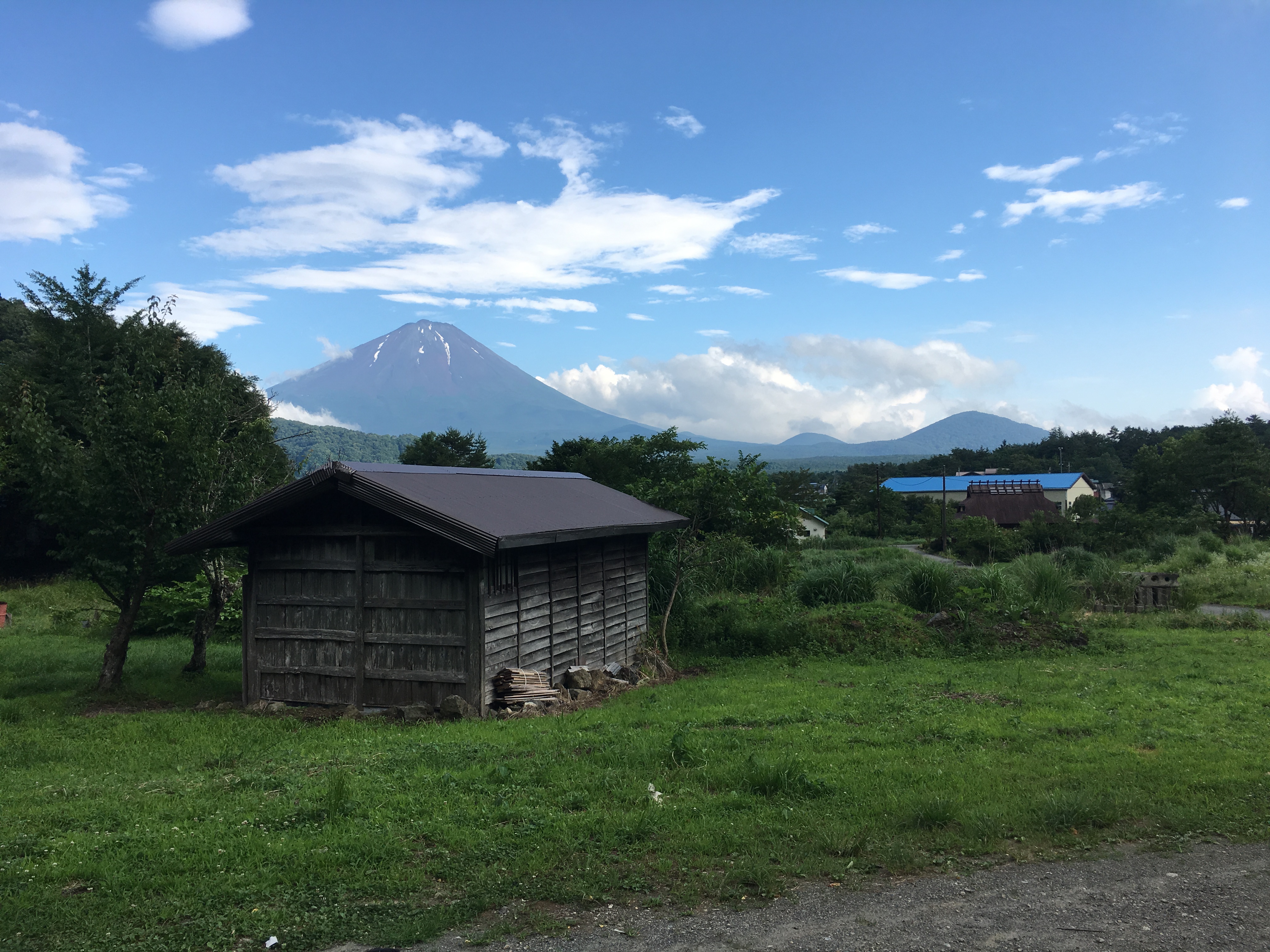
Nenba village. Our home for more than 2 weeks.
On the small scale of Nenba, even an aging population seems to be self-sustainable by means of opening small businesses in the local tourism industry. However, on a national scale, an aging population poses many threats to the country’s economy. The first concern that can be easily associated with aging population is the declining workforce. As the ratio of non-working people to working people increases, there would be a smaller portion of working adults to support the economy and the aging, non-working class. Furthermore, an increase in educated, highly skilled working adults also pulls labor away from the peripheral areas such as the countryside and towards the cities. This is because cities often offer more employment opportunities and higher paying jobs than the rural areas. Such a problem has been reflected in the struggle to recruit younger rangers and volunteers at National Parks (NPs) all across Japan (Aramaki, 2017). During our volunteer work at Lake Motosu with the Aoki Club, this was also apparent, since all of the trail maintenance experts were also of retirement age.
I was curious whether Japan has devised any scheme to counter the effects of its aging population. While the Singaporean government has been battling this issue by increasing the number of immigrants in order to replenish the workforce, Japan pursues a more contained, self-sufficient solution: automation. Japan has long been at the forefront of mechanical engineering and automation. From vending machines to conveyor belt sushi restaurants, Japanese have managed to maximize automation and minimize human employment. One prime example that we saw on the trip was the Asahi bottling factory. With an area of 98000 square meters and the capability to produce 40 million boxes of drink every year, it only has a total of 200 employees, only 70 of which work in the production chain. In fact, as we walked through one of the bottling areas, it was said that only two to three people were needed to operate production at any given time (Asahi, 2017).
While Japan continues to amaze me with its technological advancements and manufacturing self-sufficiency, automation is still not the one-size-fits-all solution for the puzzle of aging population in Japan. Clearly, it would not solve the issue of under-staffing in governmental agencies such as rangers in national parks. The question remains: will Japan continue to rely on technological advances to alleviate these problems, or will it change its immigration policies once it has run out of options?
References
Central Intelligence Agency. The World Facebook. 2016. https://www.cia.gov/library/publications/the-world-factbook/rankorder/2102rank.html
World Atlas. Countries with the Largest Ageing Populatin in the World. 2017. http://www.worldatlas.com/articles/countries-with-the-largest-aging-population-in-the-world.html
Watanabe, Takenori. Lecture. 2017
Aramaki, Marisa. Lecture. 2017
Asahi bottling plant tour. 2017