
It’s hard to find something so significant to a country that also means different things to each person. For the past 7 weeks, it’s been interesting to see how Mt. Fuji serves a variety of purposes for the Japanese from recreation to business. Those who have either climbed Fuji or live near it all have different perspectives on its significance.
Both locals and visitors primarily view Fuji as a site of recreation. Back in 2008, Thomas Jones and his team conducted a four-day study on climber demographics in which they recorded the reasons why people climbed Fuji as well as their knowledge of the mountain. Of the 172,000 climbers who ascended Fuji in July of that year, the team was able to survey 927 (Jones 2017). The survey was taken along the most popular route, the Yoshida trail, which caters to tourism and casual use. Above the 5th station, where most people start their climb, there are rest huts selling beverages, oxygen and souvenir sticks with stamps. When we climbed Mt. Fuji, I noticed that there was an increase in visitors and the trail became very crowded after we passed the 6th station. There were all sorts of people climbing Fuji, from a group of five unfit Americans to a European couple, one of whom I thought was at least partially blind. There were also plenty of locals climbing Fuji for the first time in tour groups. In their survey, Jones’ team discovered that most people did not list the fact that Fuji was a World Heritage Site as a reason for climbing (Jones 2017). They also discovered that almost half of the locals climb Fuji with no other motivation besides recreation.
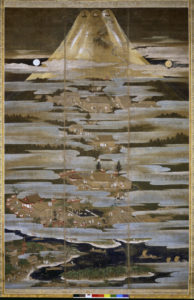 Fuji can also be viewed from a religious perspective, however. It has been worshiped for a long time by various groups, whether to quell the mountain’s destructive power or to revere it. Some of these groups are the Fujikō (Fuji confraternities), who make pilgrimages up Fuji to be reborn (Umezawa 2017). We were fortunate to experience each stage of the Fujikō pilgrimage. At the start of the trip, we partook in a Fujikō fire ritual, much like the pilgrims would, and at the foot of Fuji, we entered lava tree mold caves known as tainai where pilgrims could be reborn before climbing. While climbing Mt. Fuji, we passed by many mountain huts where pilgrims would stay overnight and see the goraiko (sunrise on Fuji). Also along the trail were many torii gates, signifying a sacred area. At the summit there is a shrine to worship the Fuji goddess, Konohana Sakuya-Hime. Along the climb we also saw two Fujikō members making a pilgrimage to the top. Even though the Fujikō and other religious groups are dwindling in numbers, the religious aspect of Fuji will always be there.
Fuji also provides the surrounding area with natural resources–especially water, which gets used in a variety of products. The Asahi soft drink company has a factory on the southern side of Fuji which utilizes Fuji spring water in its manufacturing of tea and bottled water (Asahi Soft Drinks 2017). The company markets the water as exceptionally pure and tasty. Fuji spring water is also used to manufacture paper (including toilet paper) and to grow tea on the southern slope. Since Fuji springs produce so much water, companies can afford to use large amounts of it. To them, Mt. Fuji is a resource that can be used to make money.
There is nothing in the world like Mt. Fuji, a mountain that attracts tourists and locals alike, a mountain that is worshiped by various groups, and a mountain which is used both for products and marketing by businesses. The time I spent on and around Fuji helped me to realize how special and important it is to everyone, whether they know it or not.
References
Asahi Soft Drinks. 2017. “Asahi Soft Drink Fuji Factory Tour.” Fujinomiya-shi, August 2.
Thomas, Jones. 2017. “Monitoring Visitor Diversification at Fuji-Hakone-Izu National Park.” Fujinomyia, 8 2.
Umezawa, Fumiko. 2017. “Mt. Fuji, Believers, and Local Society in the 18th and 19th Centuries.” Tokyo, July 1.