
The following discussion will spring from analysis done by Stephen Kellert. Kellert recognized nine attitudes towards wildlife (which I will generalize to nature more generally) and quantified the extent to which people in America and Japan identified with those attitudes (1993). American responses showed a preference for wildlife in natural or wild circumstances. Japanese responses, in contrast, revealed an appreciation of nature largely through highly curated settings. This contrast is reflected in the conversations surrounding preservation in both locales.
In the US, the conversation about preservation centers on expanding urban environments. Cities are growing and infringing upon spaces that were once “wild.” Of course, the concept of wilderness is a fantasy, but it is a fantasy often called upon. In Japan, the conversation focuses on the disappearance of the satoyama (or countryside) environment (Haru Saito, 7/18/2017). People are moving to cities, and those who stay in more rural areas no longer need to maintain the area around them in the same way their ancestors did. People no longer need to grow grass for thatch, and herb collecting is not enough to motivate the intense disturbance which once occurred to maintain grasslands. Despite the differences, however, people in both the U.S. and Japan face the same challenge: how to interact with nature constructively now that the overlap between human environments and natural ones has shifted. Design is a very important aspect of this. The way we build the world around us, and thus the way we interact with it, changes the way that world is perceived.
This is the Gembugawa, a stream in the town of Mishima.
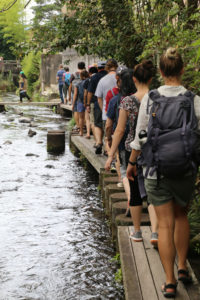
In the ‘60s this river was unrecognizable from what we see today and from what was seen before the area was overrun by factories flocking to the pure Fuji spring water (Ground Work Mishima, 8/10/2017). The surrounding areas dumped garbage into the stream and drainage was discharged directly into the waterway. In the ‘90s, Gembugawa was given a new life by the organization Ground Work, which rallied the community to rehabilitate the space. Not only did they clean up the river, but they transformed it into a usable and welcoming space. Physically, they didn’t change much. They cleaned up trash, added some access points to the river, and made a path along the water. But this transformed the space. The river became a park, a busy corridor through the heat and bustle of the city. The walkway bustles with dogwalkers and others, just out for a stroll. Children play in the stream – and so do adults.
Opening the river has invested people in its vitality. The beauty of the space lures people into the natural environment. Using and appreciating the space makes people care about its well being, and about the well being of similar spaces. The natural world is not just made visible and relevant by good design – it is protected by good design. As mentioned earlier, Americans don’t have as much appreciation for curated nature as Japanese. Thus, there is less demand for such curated spaces. But perhaps we should make creating such spaces a priority. Getting people into the water will make them care about keeping the water clean, no matter where they are.
Work Cited:
Kellert, Stephen R. 1993. “Attitudes, Knowledge and Behavior Toward Wildlife Among the Industrial Superpowers: United States, Japan, and Germany.” Journal of Social Issues 49 (1): 53–69.