
“Namu Amida Butsu
Namu Amida Butsu
Nam mô A-di-đà Phật…”
When I was a child, at the start of every school year, my mom and I would be filling in my particulars in my yearly report book at school. I still remember how she would put a little mark in the check box by the word “Buddhist” under the religion section. Even when I started to fill in report books by myself, I would still obediently put a mark in that check box. However, I stopped doing so when I got to eighth grade. Instead, I started to check the box that said “Free-thinker.” Even now, I am still unsure what prompted that change in me. For certain, I did not hate Buddhism, but perhaps the fact that I was born into it made me feel like an unwilling follower. Despite having learned about Buddhist teachings and attended temple ceremonies with my devoted mother and great aunt, I was never convinced by its belief. My estrangement from my family’s Buddhist tradition only grew when I left Vietnam to study in a Christian school in Singapore. For the first time, I had the choice to learn about a new religion. The unfamiliarity of the new religion piqued my interest, and I was more curious to learn about it than I had ever been with Buddhism. Buddhism became just a part of my childhood that I’d left behind. Little did I know, that part of my childhood would turn out to be such an integral part of my experience in Japan. Learning about Buddhism in Japan not only brought me back to the childhood that I thought I had forgotten, but also opened me up to new perspectives of the religion in a different context. The similarities and differences I have experienced in Buddhism in Vietnam and Japan have renewed my curiosity and interest in learning more about the religion.
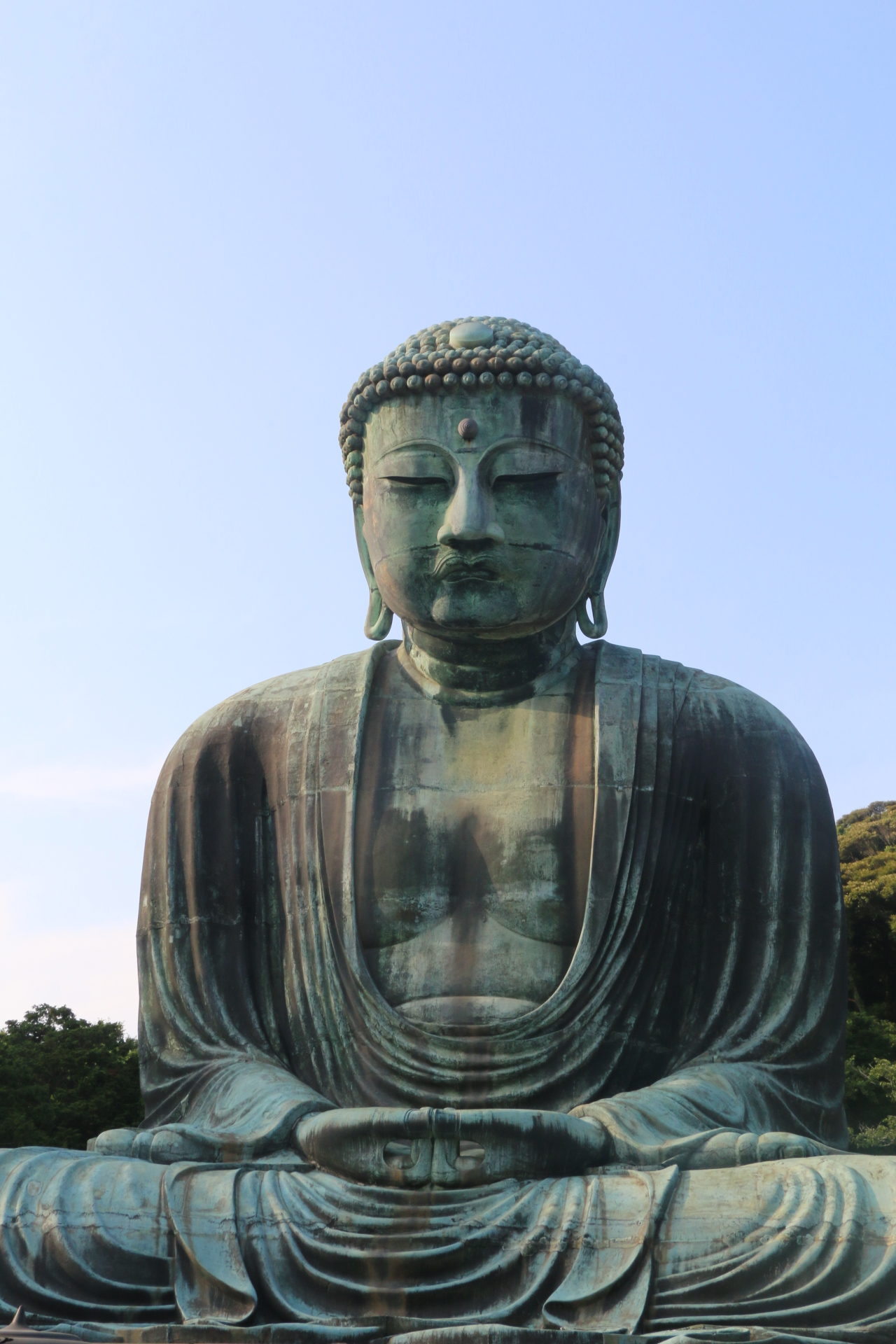
Kamakura Daibutsu- a great bronze statue of Amida Buddha in Kamakura.
Buddhism in Japan, much like Buddhism in Vietnam, originated in India but was adopted through China. There are many similarities in the doctrine and practices in both countries. As my opening quote, the recitation of Amida Buddha’s name in both Japanese and Vietnamese, illustrates, many Buddhist sects in both countries worship the same Buddha. Furthermore, these sects also adopt the same teachings and sutras from the original scriptures in India, hence the similarities between the chants even in different languages. Other Buddhist elements such as the use of incense and the manji symbol also reflect similarities between the two countries. In fact, Vietnam and Japan share one of the major sects of Buddhism, Mahayana Buddhism, and one of its most prominent scriptures, the Lotus Sutra (Myoho Renge Kyo in Japanese and Diệu pháp Liên Hoa kinh in Vietnamese) (Hanh, 2003).
Since the start of the program, I’ve been struck by the familiarity of these Buddhist aspects during our visits to several Buddhist temples such as Sensoji temple in Asakusa, Tokyo, Hase-dera and Daibutsu in Kamakura, and the Murayama Shugendo temple in Fujinomiya. Still, the highlight of the program for me was our visit to Taisekiji temple. Taisekiji is the main temple of the Nichiren Shoshu Buddhist sect, whose main object of worship is the Dai Gohonzon – the name of the Lotus Sutra inscribed by the founder Nichiren Daishonin (Taisekiji, 2017). One of their main practices is gongyo, which entails reciting the name of the Lotus Sutra: “Namu Myoho Renge Kyo.” We were fortunate enough to attend one of the evening gongyo ceremonies where we kneeled together with the worshipers and student priests with the juzu (rosary) in our hands and recited the sutra for half an hour. The ceremony immediately gave me flashbacks to similar experiences I had as a child. I remember the rosary my great aunt gave me when I was eight that I no longer use, the sutra book that my mom used to read to me like the one a worshiper was reading to her grandson at gongyo, and the reverent atmosphere that filled the room when the priests started to chant to the rhythm of the drum. The unsettling familiarity made me feel nostalgic yet also alienated. I was at once an insider and an outsider. These polarized feelings made me feel uncomfortable as I sat through the ceremony. It was a reminder of something I thought I had left in the past and was no longer a part of, yet it was not unwelcome. Ultimately, the experience that I had at Taisekiji has renewed my curiosity and interest in Buddhism that I have long neglected.
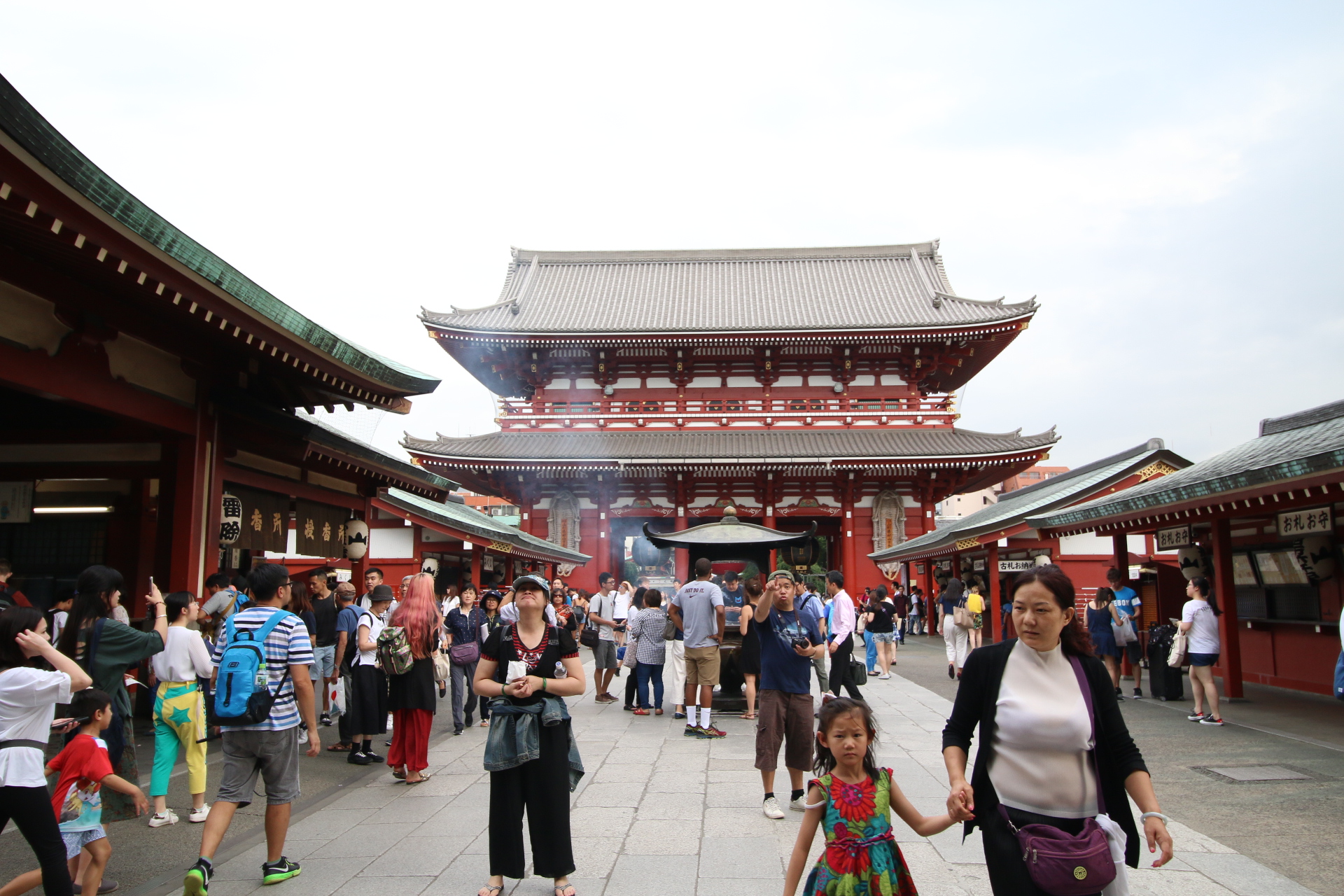
Sensoji Temple- the most popular Buddhist temple in Tokyo
At the same time, it was also extremely intriguing to see the differences between Buddhism in Japan and Vietnam. For example, Buddhist priests in Japan are generally allowed to get married (Murayama, 2017) while they are not in Vietnam. However, the most apparent difference was the integration between Buddhism and Shintoism in Japan. Instances of the mixing between Buddhism and Shintoism can be found in shrines and temple around Fuji – a historical object of worship for both religions. We saw the manji all around and remnants of Buddhist statues at Kitaguchi Hongu Sengen Shrine in Fujiyoshida (Bernstein, 2017). These differences not only helped me to grasp a better understanding of the history of Buddhism in Japan, but it also made me curious about other aspects of Buddhism I was unaware of in my own country.
As the priest at Taisekiji told us, there are three stages to enlightenment: awareness of your inner Buddha, understanding your inner Buddha, and practicing as a Buddha. Even though my experience in Japan might not be the start of my path to enlightenment, it has been my journey to renew my interest in the Buddhism of my childhood – to rediscover my inner Buddha.
References
Bernstein, Andrew. Lecture. 2017.
Hanh, Thich Nhat, Opening the heart of the cosmos: insights from the Lotus Sutra, 2003. Berkeley, Calif.: Parallax. ISBN 1888375337.
Murayama Shugendo Ceremony. 2017
Taisekiji Temple Tour Guide. 2017