
I’m sitting in a bakery café in Shinjuku, a popular shopping and business district of Tokyo. The floor rumbles as trains pass underneath the building, but it’s largely drowned out by the upbeat ‘60s American jazz and lively social chatter among fashionable Japanese women. I realize that it’s been a little while since I’ve seen this many young people. Tokyo buzzes with youth culture, but the largest demographic in Japan is actually much older—the “65+” generation.
If they aren’t visible in Tokyo, then where are all the Japanese retirees? They’ve become the primary inhabitants of rural Japan. While old family heads hang on to the land their ancestors farmed, the youth have moved to the cities despite pleas from their parents to return home (see the last chapter of Simon Partner’s Toshié for an example). Rural Japanese villages are aging with the nation’s population, and many of them are dying out without young families and young workers (lecture by Marisa Aramaki, 6 July 2017). Postal services are even being discontinued to “dying” villages under the assumption that soon there will be no one living there to receive mail. This also means that no one will be maintaining the landscapes and industries in these areas. Without young workers in rural areas, carefully maintained countryside landscapes and vital economies based on forestry, agriculture, and tourism could suffer heavily.
Japanese people are not ignorant of this problem. Regarding the low number of national park rangers, volcanologist Shigeo Aramaki asked my cohort, “How do American national parks get young people to become park rangers?” We tried to explain youth culture and job mobility in the States, but he eventually gave up and cut us off, stating that he simply didn’t understand.
But why do Japanese national parks have so few rangers? And what does that mean for Japanese national parks and rural areas? The Japanese national park system only has about 270 park rangers, and most of them are paper-pushers. Those who work on-site consistently are called “active park rangers,” but they’re really seen as “part-time support rangers” on short-term contracts—and there are only about 90 of them (Marisa Aramaki, 6 July 2017).
Put simply, there just aren’t enough young Japanese who want to live and work outside the cities. Urban lifestyles are convenient, fashionable, and respectable. As much as I loved living for two weeks in rural Japan, even I have to admit that a having a 7-Eleven within walking distance makes life much easier. Modern Japanese cities scream “cosmopolitan” with their Roman-alphabet shopfronts whose ads depict white models in Western brand clothing—and according to an insider, Japanese love all things “Western.” There’s also a lot of social pressure for young, promising students to become company employees, doctors, or other “high ranking” societal members. These positions are generally concentrated in cities, and with minimal job mobility later in life, a low-security three-year contract as a park ranger holds little attraction.
To return to Dr. Aramaki’s question, then, my answer would be this: the American economy allows and even expects job movement in order for workers to gain experience before being hired for upper-level positions. For the time being, national park rangers feel comfortable and supported enough to live on the salary and benefits of their position. Some will move on to other positions later in life, and others will retire as park rangers. There is also possibly better status attached to American ranger work; a bachelor’s degree is required for many positions.
Some young people may also simply feel less personally interested in national parks. The overall number of visitors to national parks has decreased over recent years, indicating a generally decreased interest in the parks among Japanese (Marisa Aramaki, 6 July 2017). Additionally, because young Japanese are living primarily in cities, few of them are stakeholders with an invested interest in park management (Hiwasaki, 2005).
So what will bring young workers back to the countryside to be park rangers, foresters, and tourism workers? The current socioeconomic climate seems to impede solutions. Dramatic institutional changes will be necessary to fill the gaps in aging rural communities. Perhaps it will take an increase in Japanese job mobility, or more permanent contracts for workers, or even a new immigration policy. Whatever solution is chosen, however, will probably need to be implemented quickly—this problem has an imminent deadline.
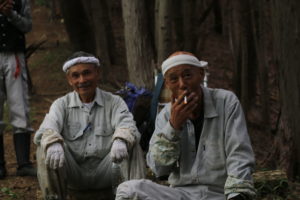
Some of our leaders in a trail building project near Lake Motosu, all of them seasoned experts.
Works Cited:
Hiwasaki, Lisa. 2005. “Toward Sustainable Management of National Parks in Japan: Securing Local Community and Stakeholder Participation.” Environmental Management 35 (6): 753–64. doi:10.1007/s00267-004-0134-6.