
Since coming to Japan, my studies of Mt. Fuji have led me to think of the mountain as primarily a site of religious and cultural significance. Yet since I have been studying Fuji for six weeks, there are differences in how I perceive Fuji compared to how other tourists do. During the climb, I was focused on finding cultural and historical aspects of the mountain, but I frequently had to remind myself that Fuji has more identities than one. Fuji is a “cultural national treasure” (Bernstein, 2008), making the mountain an important site for international tourism and a significant figure of worship. After the climb, I had to put myself in the shoes of the average tourist for a moment and consider how my impression of the mountain would have been different without the historical knowledge of the mountain I have now.
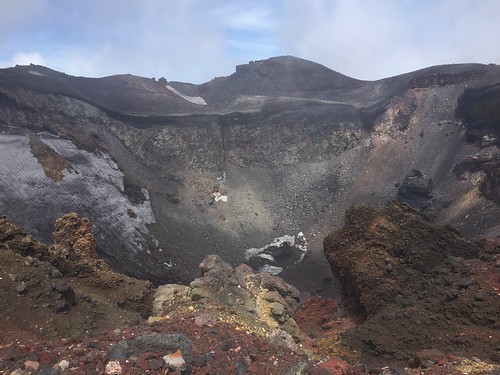
Fuji crater at the summit.
In one of our presentations by Thomas Jones (08/02/17), I realized I was in the minority of Fuji climbers because of the preparation I had, such as lectures, readings and site visits. In the results of a survey his research group gives to climbers, Jones highlighted that many tourists miss learning about many of Fuji’s deep cultural roots. Since most climbers start at the fifth station, he noted that many do not get to visit the Kitaguchi Hongu Sengen Shrine or see the grand entrance up the Yoshida route. In addition, because many international aliens (the name Jones gives to foreign climbers) are uninformed about Fuji’s cultural history, many of them know nothing about Fujiko (pilgrimage confraternities) or Fuji’s religious past shared between Buddhism and Shintoism. Another statistic that surprised me was that the average climber (and to my chagrin, even myself) does not recognize the World Heritage symbol. Since Fuji was recently inscribed as a cultural World Heritage site, one might think that this would be encouraging people to climb, but statistically, only Chinese tourists were more inclined to climb due to its 2013 inscription. In fact, most Western climbers came to climb Fuji because of its natural significance, not its cultural significance. It is clear that there is a fissure between the experience many tourists have and the one I had.
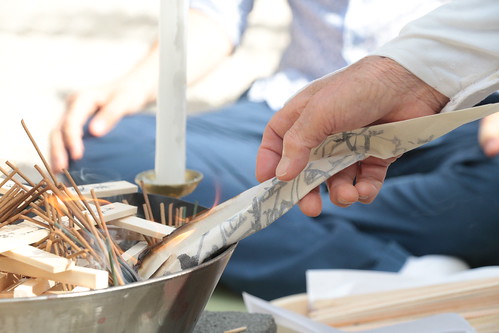
Fusokyō fire ceremony to ensure a safe climb.
My experience climbing Fuji was life changing. The climb reminded me of the unique experiences I have had which have shaped my current view of Fuji. During our second meeting with Shishino Fumio (07/25/17), the leader of Fusokyō, he was adamant about his role conserving Fujiko practices even though they were declining in today’s culture. He mentioned that his role as a member of the Shishino lineage is to preserve Fusokyō in its purest form, but he even toyed with the idea of inviting foreigners into Fujiko to continue the tradition. I was also entranced by the fire ritual performed for us by Fusokyō members (07/2/17), the Goraiko sunrise at the eighth station, the purification ritual in which a kami was placed on my head, and the time when we crawled like Fujiko pilgrims through the tainai (womb cave) lava tree molds. Other memorable experiences, such as a lecture by Fujiko expert Umezawa Fumiko (07/01/17) about how women had been previously barred from climbing Fuji, a presentation by religious historian Marco Gottardo (07/02/17) about how Kakugyo and Jikigyo Miroku popularized Fuji worship, and a field trip with self-proclaimed mad scientist Tatsuro Chiba (07/21/17) led me to a deep cultural understanding of Fuji’s identity and how the mountain came to prominence.
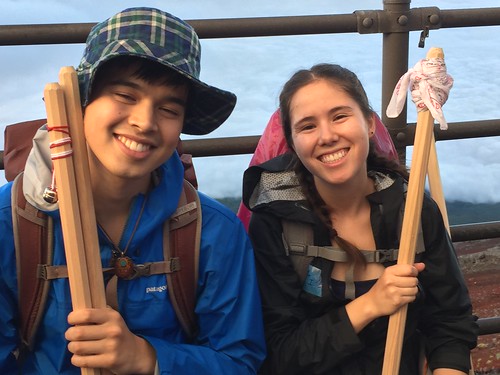
Tired climbers and Fuji clouds at the 7th station.
These experiences have made me feel as close to a pilgrim as physically and emotionally possible. When I reached the summit, I was filled with a sense of pride, but also a hint of melancholy that I was privileged enough to have a one-of-a-kind experience with Japan’s treasure that many miss entirely. Though I respect those who climb Fuji for simply recreational purposes, somehow, climbing Fuji and not being enriched with the knowledge of why Fuji is Japan’s treasure detracts from the experience. It was also easy to become caught up in the touristy experience such as the crowds of people at each station, the lines to restrooms with a two-hundred-yen maintenance fee, and the shopkeepers profiting heavily from the pandemonium. But most of all, it was disheartening to discover that much of Fuji’s rich history is invisible to the average foreign climber; there’s nothing more that I want than for the average tourist to experience Fuji the way I see it now.
Resources:
Bernstein, Andrew. 2008. “Whose Fuji?: Religion, Region, and State in the Fight for a National Symbol.” Monumenta Nipponica 63 (1): 51–99. doi:10.1353/mni.0.0001.