A week before I left to begin my journey in Japan, I visited the summit of Mauna Kea to watch the sunset and stargaze. Little did I know that I would soon draw intriguing parallels between the mountain of my home and the mountain I would climb on my trip. Now that I have experienced Mount Fuji firsthand, I can situate aspects of Japan’s iconic mountain alongside Mauna Kea. There are fascinating similarities and stark contrasts, both of which I will explore below.
Mauna Kea, located on the Big Island of Hawaii, stands at 4,207 meters. Mount Fuji, just west of Japan’s capital, stands at 3,776 meters. They are the tallest peaks in their respective island chains and composed of basaltic lava rock. The Japanese people have worshiped Fuji for centuries just as Native Hawaiians have revered Mauna Kea in their own religious practices. Both cultures view the summits of their mountains as sacred spaces that are the realms of the gods. Interestingly, both mountains are associated with female deities, one being Poliahu, the Hawaiian goddess of snow, and the other Konohana-sakuya-hime, the princess of Fuji. Over 10,000 acres of Mauna Kea have been designated as traditional cultural property due to its numerous archeological sites, shrines, and burials. In 2013, Mount Fuji was recognized as a cultural World Heritage Site since it is an object of worship and a source of artistic inspiration for the Japanese people (Kondo, 2017). Mauna Kea and Mount Fuji are both acknowledged as significant cultural spaces to some degree, but there are substantial differences in how each mountain has developed historically.
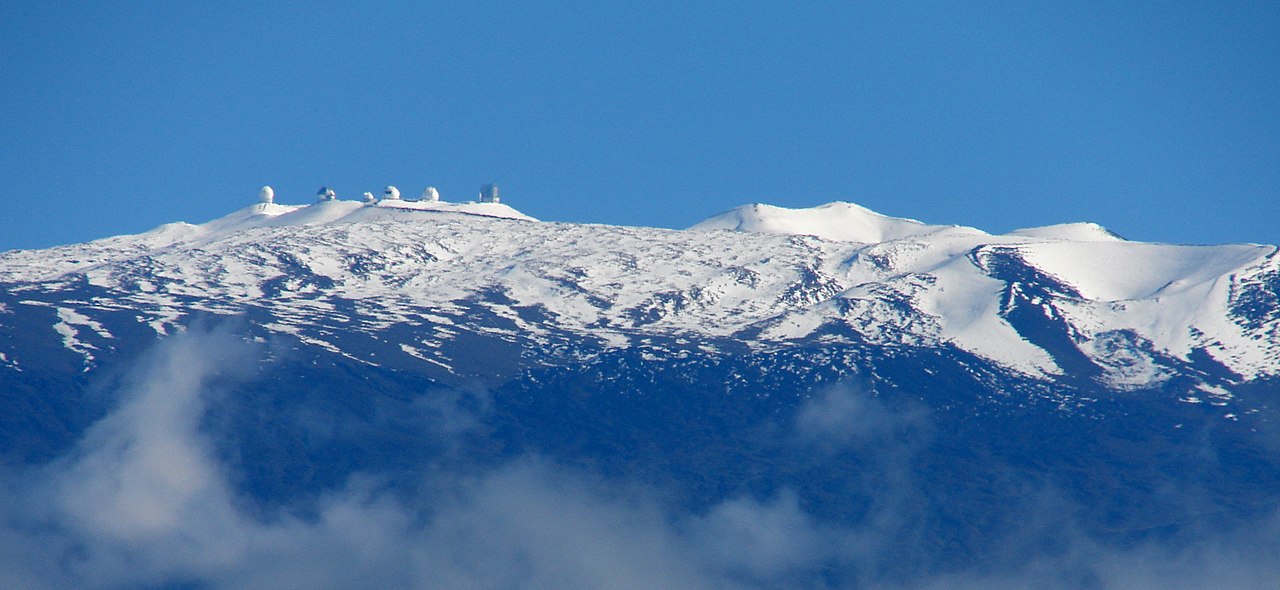
Mauna Kea, a 4,207 meters-high shield volcano

Mount Fuji, a 3,776 meters-high stratovolcano
Mount Fuji has been a popular pilgrimage site for worshipers since the Tokugawa period (Miyazaki, 2005). Infrastructure that included bathrooms, inns and tea shops was established along pilgrimage routes in order to accommodate the travelers, many of whom journeyed all the way from Edo/Tokyo. Tourism and religion were inevitably intertwined on Japan’s sacred mountain and have been linked for centuries. This helps to explain how Fuji has been popularized as a prime destination for hikers. Today, approximately 300,000 climbers from Japan and around the world hike to the summit during the two-month summer climbing season (Jones, 2017). Mauna Kea receives about that many visitors in an entire year. Furthermore, these visitors do not typically visit for the purpose of hiking; instead they travel to the summit by tour bus to watch the sunset and stargaze. Mauna Kea does not experience the crowds and heavy congestion that are characteristic of Fuji’s climbing routes. Furthermore, if visitors did want to hike to the top, they would have to do so without any rest areas, food, or restrooms after passing the visitor’s station at 2,800 meters.
There are several reasons why Mauna Kea has not transformed into a booming hiking destination like Mount Fuji. One of the most significant reasons is that, unlike Fuji, there is a road leading all the way up to the summit. This gives visitors the easy and accessible option of driving rather than an 8-hour hike. In ancient Hawaiian history, only the ali’i (royalty) and kahuna (priests) were allowed to summit the mountain. It was not a commoners’ mountain, as Fuji was often referred to as, so a pilgrimage culture never emerged. Other than the astronomical observatories in the science reserve area, no development activity can occur on Mauna Kea due to its designation as traditional cultural property. Luxuries such as bathrooms and lodgings cannot be offered since the land must be conserved. The visitor’s information station was not even constructed until 1982 and it was initially built with the aim of helping the astronomers and technicians acclimate before reaching the summit.
Whereas Mauna Kea has earned the reputation of being the astronomy capital of the world, Fuji has been popularized as a prime destination for hikers. It is clear with the low visitation, relative to that of Fuji, that Mauna Kea’s current purpose is mainly scientific and educational. Before actually climbing Fuji, I thought I would discover more similarities with Mauna Kea than contrasts. However, despite their religious significance to Japanese and Hawaiians, Mount Fuji and Mauna Kea have clear distinctions. This is evidenced by the differences in commercial development, or lack thereof, and the purposes they serve to their visitors today.
Bibliography:
“About Mauna Kea Observatories.” About Mauna Kea. 2016. Accessed August 03, 2017. http://www.ifa.hawaii.edu/mko/about_maunakea.shtml