
Katsushika Hokusai’s (1760-1849) Thirty-Six Views of Mount Fuji is a collection of woodblock prints that depict Japan’s iconic mountain from various angles and perspectives. In one of the more recognizable prints from the series, Fuji commands the entire piece and its steep profile is portrayed using an intense reddish color. This print, known more commonly as Red Fuji, shows the striking reddish tinge that is characteristic of Fuji due to the red-colored scoria of its slopes. With the right lighting, those who gaze upon Mount Fuji from afar can often see a slight red shade along the mountainside. I have glimpsed the red hue of Fuji myself, but recently we have learned about the mountain from a much “greener” point of view.
While you may not think of a mountain as sustainable, physical elements of Mount Fuji and ecofriendly practices are connected in today’s modern Japan. One example of this can be seen on the western slope of Fuji where sabo activities are utilizing the mountain in remarkable ways. Sabo refers to the act of employing technology to prevent and control natural disasters. In the case of Mount Fuji, sabo engineering has been implemented to prevent damage from debris flows that originate in the Osawa failure. The Fuji Sabo Office has focused their efforts at the Osawa alluvial fan located at the base of Fuji in order to stop devastating debris flows from traveling further down to populated areas. A series of countermeasure facilities slow down and channel the debris flows into sand pockets where the sediments can then be removed and stored (Fuji Sabo Office, August 9, 2017).
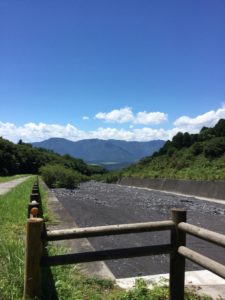
The sustainable aspect of this project came into play beginning in 1998. The Fuji Sabo office started to screen and fracture the rocks and sand from captured debris flows with the aim of repurposing the sediment. To date, the recycled sediment has been used in multiple public work projects including beach improvement materials on the Fuji coastline and road bed materials in Shizuoka prefecture (Fuji Sabo Office, August 9, 2017). The work of the Fuji Sabo office is not only averting potential disasters but also incorporating the mountain into ecofriendly practices. The Osawa failure has been eroding for the past 1,000 years (Sou Anma, August 9, 2017) and debris flows are expected to continue, meaning that sediment materials can continue to be accumulated for future recycling.
Another physical element of Mount Fuji is utilized at the Corelex paper factory in Fujinomiya. Spring water on the south side of the mountain is pumped from five different wells and transferred to a processing plant. Corelex uses about 15,000 tons of water per day to transform 230 tons of waste paper products into 150 tons of tissue and toilet paper. The waste water that results from the recycling process cannot be utilized again, so a portion of it goes towards agricultural irrigation in the Fujinomiya region. Some of the water is also drained into the Fuji river which Corelex claims has little effect on the river’s ecosystem (Okada, August 9, 2017).
At face value, Corelex is a low-emissions factory that utilizes recycled products to make everyday household items. Although the factory is able to repurpose what would otherwise be trash in a landfill, an extremely large amount of water is needed to soak the waste paper and separate it from unwanted materials. More water is needed at Corelex than other paper plants because of the initial recycling process (Okada, August 9, 2017). Spring water from Mount Fuji is being used for what can be considered an ecofriendly practice, but a larger picture of the overall processes that extend beyond what transpires at the factory is needed to determine the aggregate of ecological benefits.
Elements of Fuji have been used for centuries, but today we see a more modern approach at the Corelex paper factory and with the Fuji Sabo Office’s work at the Osawa alluvial fan. These two sites are utilizing the mountain in very different manners, but both are attempting to use Fuji in the most advantageous and ecofriendly way. From an artistic perspective Fuji may be red, but in today’s heightened ecological awareness Fuji can be seen as green.
Link to the Fuji Sabo Office website: