
The greater Fuji region is no stranger to mudslides and yukishiro (slush flows), especially places near mountains. When we stayed in the town of Nemba by one of the five great lakes of Fuji, Lake Sai, I was awestruck by the rolling hills covered in thick forest. At first the town struck me as a quaint mountain-side tourist village, but it did not take long to notice evidence of the mudslide that had devastated the town just decades before. A survivor of the disaster and member of the city council, Takenori Watanabe (Watanabe T, 2017), gave a presentation to us detailing the history of the village and the 1966 mudslide. Miraculously, out of forty households, he was crouching in one of the five that survived the disaster. Although these disasters are often unavoidable and exacerbated by human presence, engineering marvels called “sabo” have been used to abate debris flows for a safer future.
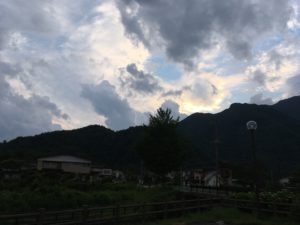
Sunset above Nemba village foothills.
Mudslides have a strong connection to Japan’s land-use history, especially during the recovery period after World War II, when hillsides were largely deforested. Today, these slopes are forested but unmaintained. To help explain this, of Kazumasa Masuyama (Kazumasa, 2017), a forestry expert, mentioned during a lecture that due to the decrease in demand for domestic wood products from international competition, many Japanese tree plantations are not being cut down for timber. A sustainable forestry researcher by the name of Sadamoto Watanabe (Watanabe S, 2017), explained on one of our field trips that because of how dense overgrown plantation forests are, individual trees each receive less light and cannot develop their root systems as much. Because of weaker root systems and a low amount of undergrowth (which helps the soil stay in place), the ground is more prone to erosion and mudslides than a well-maintained forest.
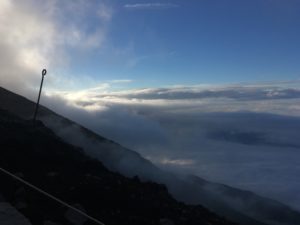
Fuji’s rocky slopes above the 7th station.
Unlike mudslides, yukishiro are a type of flow that carry snow, slush, and ice, picking up soil and scoria along the way. These are especially dangerous for climbers because of the freezing temperatures and debris carried with it. Although these flows are often unpredictable and are caused by annual weather patterns, the issue of yukishiro could be worsened by anthropogenic climate change. An expert on yukishiro, So Anma (Anma, 2017), remarked that these flows generally take place on a seasonal basis under two circumstances. First, in winter when snow is pushed into depressions by westerly winds, the ground becomes increasingly unstable when the snow accumulates. Second, yukishiro can also occur at the start of spring when snow melts or when the frozen ground melts. This is particularly important because Fuji experiences a snow-shadow at the beginning of winter. Dry, cold air is carried onto Fuji and much of the ground freezes. When spring comes, the ground begins to thaw and may fail along the permeability boundary between thawed and still frozen ground.
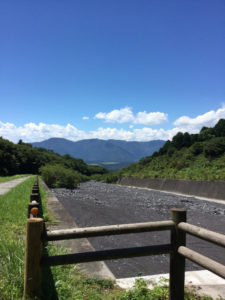
Osawa failure debris funnel leading to the alluvial fan, bank system and groundsels.
To counteract flows of all kinds, dams have been built to prevent damage to towns and protect climbers. These can be seen in both the foothills of Nemba and on the upper slopes of Fuji itself. It is sabo engineering projects like this which are being used nationally to control and redirect flows. We were fortunate enough to visit the Osawa Kuzure, a failure on the western face of Fuji which is an example of a runaway erosion problem caused by water/rock interaction. Osawa’s mechanism of collapse occurs by scoria layers being flushed out by erosion (Sabo Faculty, 2017). Following this, bare lava layers are revealed and break under their own weight. But until we saw the Iwadoi Monitoring Station above the sedimentation basin, I did not realize how severe these flows could become. Below the Osawa Kuzure, concrete bank works and cinderblocks called Grounsel have been lined up along to control the spread of the flows and redirect them away from densely populated areas. These structures are designed to take the river that flows through the Osawa failure and fix it in place so it does not move around the alluvial fan. My biggest takeaway from the site visit was how it highlighted the immediacy of Japan’s struggle with natural hazards, showing how these hazards can destroy a town or alter a landscape without proper damming.
Because of their ability to uproot both trees and towns, debris flows are a tragic consequence of living in such a mountainous landscape. Historically and even today, debris flows have posed a major threat to development in the greater Fuji-Hakone region. However, efforts have been made to control them. Dam systems such as those along Fuji’s slopes or in Nemba control smaller flows, while complex and sprawling concrete structures have been constructed on the alluvial fan of Fuji’s western face underneath the Osawa failure. These are examples of how engineering progress and discoveries about Japan’s hazardous landscape can save lives.
References
Sabo Faculty. 2017. Osawa Kuzure Flow Control System. Performed by Sabo Faculty. August 9th.
Masuyama, Kazumasa. 2017. Japanese Forestry and Management. July 6th.
Sadamoto, Watanabe. 2017. Methods for Improving Plantation Forest Management . Fujinomiya. August 12th.
So, Anma. 2017. Mt. Fuji and Yukishiro. Fujinomiya. August 8th.
Takenori, Watanabe. 2017. The History of Nemba. Nemba. July 19th.