
They are everywhere! I was floored by the series of immense dams we discovered on an afternoon hike into the canyons behind the village of Nemba. Rising like fortresses above the bone dry stream bed, each one stood larger and more formidable than the last. Gazing at all these towering walls of concrete packed into such a small drainage, I couldn’t help but wonder – is this too precautionary? Not in Japan. No country safeguards and re-shapes its landscape like Japan does. Japan has suffered great damage over the years from natural disasters like debris flows, slush flows and landslides. Over the course of our program, we have come across all sorts of dams, concrete channels, and tunnels that were built for protection against these natural disasters. Although built for precaution, these structures reflect Japanese views of nature as something to be controlled – to be enjoyed from a safe, structured space. These dams and channels provide such a space. People must be safeguarded to appreciate Japan’s natural settings and live securely amid their unpredictability.

Sabo dam behind Nemba
Japan’s mountainous topography combined with its extreme weather conditions are the primary causes of destructive debris flows. The village of Nemba is a prime example. In 1966, heavy rainfall on the steep surrounding topography resulted in a massive debris flow that wiped out 35 households, killing 35% of the village population. It was this disaster that prompted extensive dam construction in the area. Since construction of the dams, debris flows have not harmed the village (Watanabe Toshiyuki, July 21 2017). Other nearby residents around the base of Mt. Fuji face similar threats, like those beneath the Osawa Failure. The Osawa Failure is a steep and cavernous crevasse eroded into the western face of Mt. Fuji. During extended periods of heavy rain, The Osawa Failure channels destructive debris flows that threaten lives downstream. Due to several disastrous debris flows in the 1970s, “a lot of dams were constructed along Osawa Valley along the western flank of the volcano” (Fuji and Hakone Field Trip Guidebook, 2007). The Mt. Fuji Sabo office – an organization dedicated to preventing and monitoring sediment related disaster – built these dams. In addition, the Fuji Sabo Office constructed a concrete channel to re-route and contain flows, along with a monitoring station to measure them. These public works have prevented several flows from abolishing downstream residences (Mt. Fuji Sabo Office Lecture and Tour, August 9 2017).
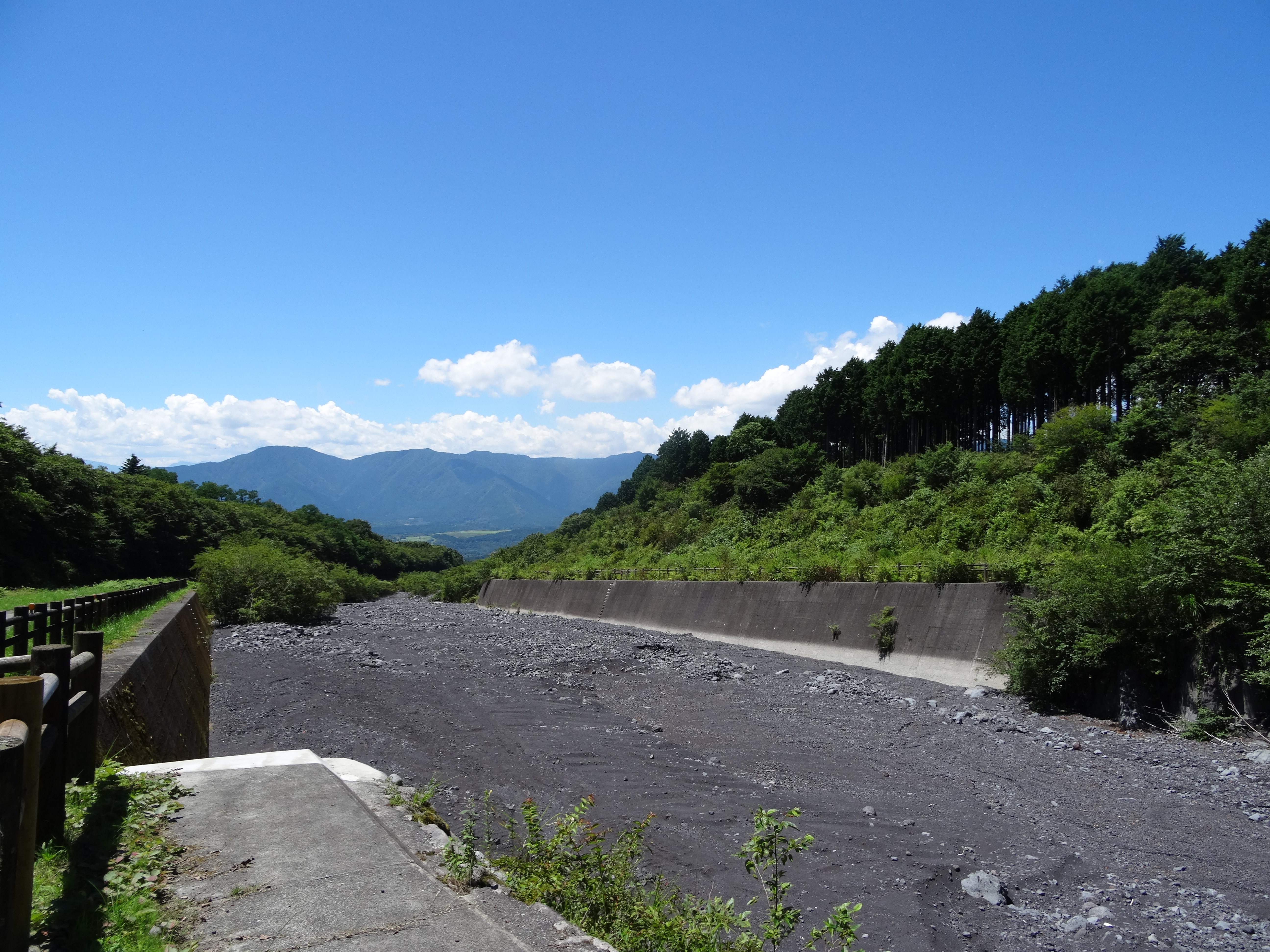
Debris flow channel at the top of the Osawa Alluvial Fan
These public works were clearly built to prevent recurrence of past disasters, to tame and redirect debris flows. Such efforts to rework drainages mirror certain trends that surfaced in a study done by Stephen Kellert. Kellert’s study compared American, German and Japanese perspectives on nature and animals. In his study, the Japanese interviewees expressed a theme of “enjoyment of nature and animals in highly structured situations” (Kellert, 1993). This necessity for “structure” implies a need for human control in nature. The Osawa Failure project controls the Osawa River as it re-routes the course of the river over its alluvial fan. Debris flows used to spread out at this location but they are now forced into a single concrete channel. This project aims to safeguard people by setting up distinct barriers between humans and the natural forces that threaten them. Residents below the Osawa Failure can now live securely despite the unpredictability of debris flows.
Although many of Japan’s residents may be safe from debris flows, other forms of natural disaster like volcanic eruptions or earthquakes continue to be threats. Ongoing possibility of disaster certainly lingered in the back of my mind as we explored the steep ridges behind Nemba or climbed Mt. Fuji itself. Such history definitely remains in people’s minds. However, it is also these aspects of danger that make Japan’s landscapes dynamic and interesting to visit. It is remarkable how well Japan has coped with and adapted to living among the constant threat of disaster. Hopefully, with ongoing maintenance and monitoring, Sabo will continue to successfully channel destructive debris flows for years to come.
Works Cited
Kellert, Stephen R. “Attitudes, Knowledge, and Behavior Toward Wildlife Among the Industrial Superpowers: United States, Japan, and Germany.” Journal of Social Issues 49, no. 1 (1993): 53-69.
Mt. Fuji Sabo office. Lecture and tour. August 9, 2017.
Takada, Akira, Kazutaka Mannen, Motoo Ukawa, and Tatsuro Chiba. 2007. “A3: Fuji and Hakone Volcanoes.” In Field Trip Guide, A3:1–A3:41. Shimbara.
Watanabe Toshiyuki. Lecture, Nemba, July 21, 2017.