
Natural disasters such as volcanic eruptions and earthquakes are unsettling reminders of human fragility. There is nothing we can do to stop tectonic plates from colliding or volcanos from exploding. At most we can monitor tectonic movement, take seismic readings, prepare evacuation plans, and hope for safety. Disaster prevention planning makes it possible to mitigate the destruction caused by volcanic eruptions and earthquakes. However, it is futile to actually attempt to stop an earthquake or an eruption. Debris flows, on the other hand, are common yet devastating natural disasters that can be controlled. Japan, a country known for massive public works projects, has a long history of managing and coexisting with disasters such as debris flows.
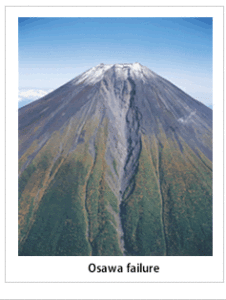
“The Current State of Osawa Failure.” Mt. Fuji Sabo Office.
The Osawa Failure, an erosional crevasse on Mt. Fuji’s western slope, began forming around one thousand years ago. The collapse was created due to the “plurality of lava flow layers and the plurality of scoria layers” which “overlap alternately on each other to constitute an alternation of strata structure … scoria layers flush out by erosion … lava flow layers fall down by their own weight” (Sabo 2015, 4). By this process, the Osawa Failure has become a 2,200-meter-long, 500-meter-wide, 150-meter-deep gash in the slope of Fuji which continues to grow today (Sabo 2015, 4).
The Osawa Failure is the perfect mechanism for generating devastating debris flows. At Osawa, debris flows are caused by the build up of erosional sediment in the Osawa valley. When the sediment becomes saturated by rainfall, it may fail and begin to travel down the Failure’s steep incline. As the flow travels down the slope it liquefies and scours, accumulating more and more debris. Our guides from the Mt. Fuji Sabo Office pointed out that debris flows have the texture of wet concrete and can travel up to 10 meters per second (Sabo, August 9, 2017). On average, each flow contains 143,000 cubic meters of sediment. When debris flows reach the bottom of the Osawa Failure they pose a massive threat to anything in their path.
Debris flows can tear through agricultural areas, forests, and villages alike. Here is a downloadable video which demonstrates their destructive power. Debris flows are not particular to the Osawa Failure; they occur all over Japan. Nemba, a village in which we lived for two weeks, was devastated by a debris flow in 1966. 35 homes were destroyed and over a third of Nemba’s population were killed due to this one incident (Watanabe Takenori, July 21, 2017).
The term “sabo” translates to mean “sand protection” (Schmincke 2005, 249). The Mt. Fuji Sabo Office was established in 1969 to counteract natural disasters created by the Osawa Failure (Sabo 2015, 2). In the past, when debris flows reached the bottom of the Osawa Failure they spread out across Osawa’s alluvial fan. From there, flows could continue traveling downstream in many directions. Through the construction of levees and dams, the Mt. Fuji Sabo Office has reshaped Osawa’s alluvial fan and made it possible to not only channel debris flows but also control them. Bank works at the end of the Osawa Failure channel debris flows along part of the alluvial fan. The Mt. Fuji Sabo Office also constructed a series of groundsel dams on the alluvial fan to stop the debris flows from continuing to travel downstream. Finally, the Mt. Fuji Sabo Office also constructed channels at the bottom of the alluvial fan to safely reroute the water of debris flows into the Osawa River. Through this engineering, the Mt. Fuji Sabo Office has managed to successfully control debris flows. Villages below the Osawa Failure are now safer than they have ever been.
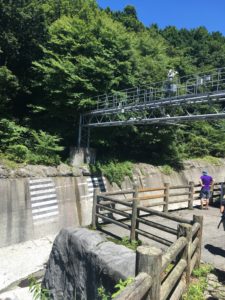
A monitoring station at the end of the Osawa Failure. Debris flows that pass through this point continue on to the alluvial fan.
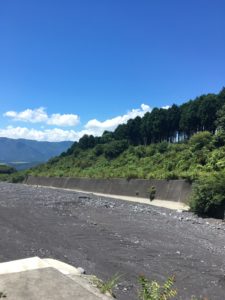
Levees at the end of the Osawa Failure which serve to reroute debris flows.
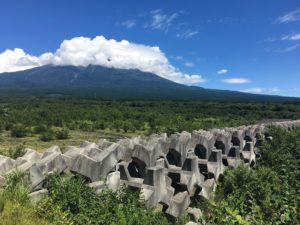
A groundsel dam. Groundsel dams are constructed with hundreds of eight-ton concrete blocks. These dams are responsible for containing sediment from debris flows.
Natural disasters like the debris flows on Mt. Fuji are extremely common all over Japan. To combat disaster, massive engineering projects like the one at the Osawa Failure have also become common. After the 1966 debris flow, Nemba constructed a series of large dams similar to those at Osawa. These dams now protect Nemba from further damage. During my time in Japan I’ve witnessed numerous other examples of controlled disaster areas. At the Mt. Fuji and Princess Kaguya Museum I learned about levees that were constructed in the Edo period along the banks of the Fujikawa delta to control flooding in that area. These levees are still in place and continue to keep villages near the Fujikawa delta safe. Habitable land in Japan is scarce. Thus, Japanese people cannot simply leave an area because it is threatened by calamity. Instead, Japan has developed impressive means of controlling powerful and devastating natural disasters.
Work Cited
Mt. Fuji Sabo Office. Lecture and tour. August 9, 2017.
———. Debris Flow at Mt. Fuji – its Features. Mt. Fuji Sabo Office. Video. 3.01-3.30. Accessed August 14, 2017. http://www.cbr.mlit.go.jp/fujisabo/en/bosai/bosaimanabu/vtr/fujisabo_movie02.html.
———. “The Current State of the Osawa Failure.” Mt. Fuji Sabo Office. Accessed August 14, 2017. http://www.cbr.mlit.go.jp/fujisabo/en/bosai/bosaikatudo/bosairekisi-genjyou.html
———. “Sabo Around Mt. Fuji.” Mt. Fuji Sabo Office. 2015, Pamphlet.
Schmincke, Hans-Ulrich. Volcanism. Berlin: Springer-Verlag, 2004. Accessed August 13, 2017. https://goo.gl/RdPZ8K.
Watanabe Takenori. Lecture. July 21, 2017.