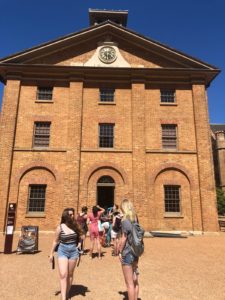
A day after we went on a tour exploring the Aboriginal history of Sydney, we went to see a piece of the other side: the Hyde Park Barracks. Now a museum, the Hyde Park Barracks were originally a convict-designed and convict-built housing construction. Regardless of its past, I can safely say that we were all glad to get in there and out of the heat and bright that made up the day outside.
Immediately outside of the barracks, we were introduced to our guide, an energetic and enthusiastic man with a minder to prevent him from ‘making stuff up as he went along’. I kind of wish I could hear the sort of stories he’d been telling other groups that made him require a minder.
Regardless of his truthfulness toward other groups, with us he was a wonderful guide. He started us out in a room describing what life for an Australian convict was like. It featured a mural that covered a long, tall wall depicting a scene from colonial life and, immediately adjacent, a massive painting of a map. Part of the room in which we stood was filled by a table and benches, set with tin cups and plates of food like that which prisoners had been served. Central to the table was a short video of convicts (well, their hands) eating and drinking from the start of the meal to the finish, intended to make the viewer feel as though they were the convict. To the side of the table was a huge cauldron—empty, of course.
There, our guide explained to us the history of early colonial Australia. He spoke mainly of the reasons for the settlement, the history underlying the shift, and its very beginnings.
Shifting to the back of the room, our guide called our attention to a table and a wooden contraption which—again—took up much of the area. There, he described the daily life of a convict, finishing with the gory details of convict punishment. From leg manacles to the cat o’ nine tails, it was a bit of a painful tale. The manacles, in particular, made me flinch; just the thought of how your life would be, with those clasped around your ankles…best not to think about it, no?
From there, we were led to a room just across the hall, where information about the colony was kept. There we learned about the colony’s management, the architect who built both the prison and the church across the way, Francis Greenway, and Governor Macquarie, who commissioned the building.
Then we headed upstairs, to view a room full of hammocks. This was where the convicts slept, he told us, packed in like sardines.
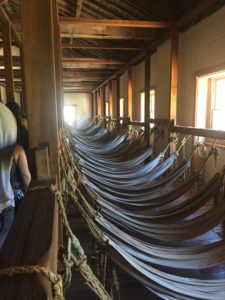
We all lay down in the hammocks, taking a try at it for fun.
Immediately after, he escorted us into a final room, where he spoke about the actual convicts. He showed us a glass case etched with the names of convicts, their crime, their sentence, and their age.
It was there that this ended, and we went home/to the botanical gardens/to wander around the museum a bit more.
All in all, an interesting day!