On our first day back from the Blue Mountains, we explored some of the local art museums in downtown Sydney. We began at Art Gallery of New South Wales, where we commenced our tour with an Acknowledgement of Country. As visitors in the country, this acknowledgement of the Indigenous people in Australia is an important part of our immersion into the culture. Throughout this gallery tour we were able to compare and contrast the colonial and Indigenous art of Australia. We were able to see the issues we’ve discussed in class reflected in the art of the corresponding time period. One painting that was particularly interesting was John Glover’s painting of Tasmania’s landscape, titled “Natives on the Ouse River, Van Diemen’s Land”. Glover was a British colonist and artists who wanted to capture the beauty of the UK’s far reaching empire. While the landscape in undeniable Australian, Glover’s European influence on the work is unmistakable. He was unable to capture the bright and vibrant colors of the Australian landscape while using the gloomy, grey color palate associated with Britain. This calm and picturesque painting marked a strong contrast of the actual situation of the traditional owners of the land and the colonists, which was full of violence at the hands of the colonists. See how the Europeans viewed the Indigenous Australians at the time, helped us contextualize the following events in Australia’s history.
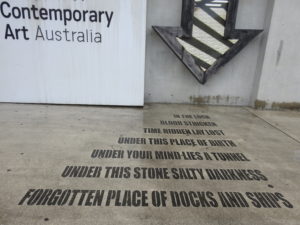
Moving on from the colonial art, we evaluated the history from the Aboriginal perspective. However, to do this we had to leave the ground level floor of the museum and travel down a series of escalators to the bottom floor of the museum. Unlike the highly uniform and stylized works of the colonists, the Aboriginal artwork came from all over the country, and utilized a variety of techniques and materials. There was a combination of ancient and contemporary techniques, as traditional styles were incorporated into the new stories. These artworks told stories of culture, loss, despair, and unity. A large component on Aboriginal culture revolved around connection. While each nation had their own customs and ritual, they were all somehow connected to their land and their ancestors. Despite the invasion and colonization of their land, these cultures and people have endured. The Museum of Contemporary Art offered a similar insight into the struggles faced by past and present Indigenous Australians. One particular art installation, tall man, used four large screens to simultaneously play footage of the 2004 riot on Palm Island. The artist, Vernon Ah Kee, a member of the Kuku Yalandji, Waanji, Yidinji and Gugu Yimithirr peoples, explored the aftermath of a young Aboriginal man’s death with in police custody. After the coroner reported that the man died from internal bleeding, tensions broke between the locals and police. Many of the pieces from both museums reflected the continual struggles and perseverance experienced by the Aboriginal Australians.
Our immersion into Australia’s past and present conflicts continued when we watched the documentary, Putuparri and The Rainmakers, which explored the fight for Indigenous Land Rights. In the film, art was used to verify the Aboriginal people’s connection to their land. Elders were able to paint from memory maps of their old home, which was presented to the National Native Title Tribunal as evidence of ownership. The film also illustrated many of the disadvantages Aboriginal people are facing today and the lack of government support and acknowledgement to make changes. The entire day helped us contextualize our surrounds and understand Australian society.
 tall man