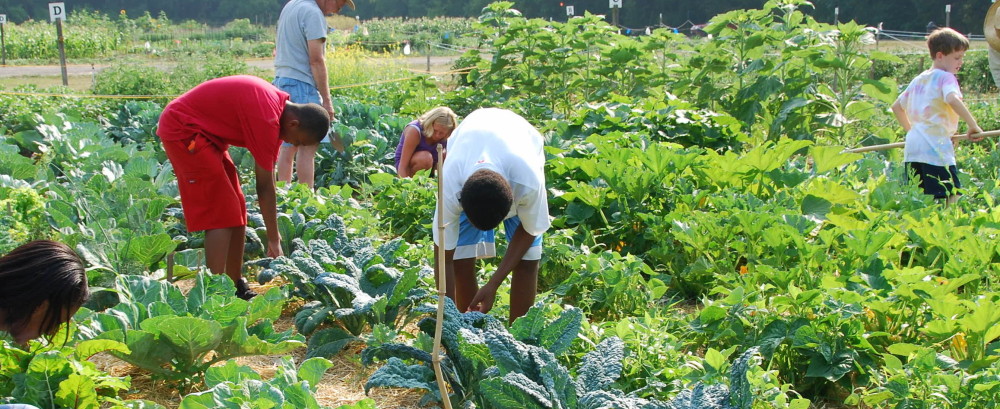
Urban Agriculture: Community Gardens in Upper-Class Portland, Oregon
Keep up to date with the progress of our project by taking a look at our posts.
Urban gardens in the United states are often associated with the benefits of community, sustainability, food security, and a connection with nature (Hynes and Howe 2004). Even beyond the US, urban gardens have been seen to promote the "bonding, bridging and linking [of] social capital" (Firth et. al. 2011). The existence, destruction, and reintroduction of neighborhood gardens can be tracked throughout history over time, between periods of war and development (Haynes and Howe 2004). As urban gardens have been reintroduced in the recent past, they have begun to diverge in a global context. On the one hand, gardens are created to continue development and food security, while on the other hand there is a desire for ownership and responsibility through collaborative gardening (Gottlieb and Fisher 1996). Laura Lawson also reviews community gardens through a historical lens, finding that urban planning rarely incorporates urban community gardening, despite the recent rise in community gardens, as they are believed to be temporary and extraneous (2004).
The broad framing question that we have posited is: what are the societal impacts of urban gardening and who, specifically, is experiencing these impacts? The spacial and temporal existence of urban agriculture suggests that it must contain inherent goodness and in some way promote well-being. Our project, group BonAddChu, works in tandem with the ENVS 220 group Gold Squad's project to provide an understanding of the relationships within Portland's urban garden community. Between our two groups, we are splitting Portland community gardens with group Gold Squad studying those located in low socio-economic areas and group BonAddChu studying those located in middle and high socio-economic areas. Our group will be using a more focused question of how communal urban gardens in middle to upper socio-economic areas create community and impact overall health and wellbeing? This question will work to collaboratively answer our larger framing question.
When answering these questions, we would like to explore and interrogate the "Portlandness" of Portland. Portland's unique geography, demographics, and values are vital to our analysis. In particular, we are interested in the "white greenness" of Portland. The city of Portland is known for two very specific things: being a very white city, and being an environmentally-friendly city, which influences the ways people interact with and feel about certain issues and values. We would like to understand the extent at which Portland's "Portlandness" impacts the ways people feel about community gardens and how they interact with them.
Related Posts
Quotations from CAN YOU DIG THIS
This chart depicts various quotations we gathered from the discussion after the film screening of CAN YOU DIG THIS by Delila Vallot. These quotations are from four individuals who spoke as a panel after the film screening. We created four classifications to dissect these quotations: opinion on the feasibility of gardening for low income individuals, […]
Actor Network Map 2.0
Here is our updated actor network map! We are looking at the ways people living in cities seek a sense of community through creating gardens as common spaces. In addition, we are exploring the nostalgia stemming from the disconnect of personal food growth in urban areas. These two factors converge to motivate individuals to create […]
Synthesis of Our Progression
Today in lab, our group finalized our project topic. We had been grappling with multiple different potentials for our topic, ranging from how non-permeable surfaces impact microclimates to how urban gardens shaped as “wildlife-friendly” habitats benefit biodiversity. On top of the difficulties surrounding trying to create a broad, non-place specific framing question, we were finding […]