The year was 2011. The place was Lewis & Clark College. The protagonist was me.
When I came to Lewis & Clark I already knew that I wanted to be an Environmental Studies major. No doubt about it. My first interests stemmed from the desire to “do something.” I was really interested in making a difference but not so sure that protests and big groups were the way to achieve a goal. I wanted to be able to do something by myself. The questions I was focusing on in regards to environmental issues included: “How can the actions of an individual have a measurable effect? Can one person initiate and carry out change?” Turns out that everyone was pretty convinced that the answer is no. Bummer. Sure, one person can try to excite and inform others but apparently one is the loneliest number, and while two is a couple and three is a crowd, you need a few more than that.
This desire to have an impact on an individual scale is the bedrock that has supported my academic interests throughout college. When it came time to construct a concentration though, I put those leftover thoughts in the fridge for later and jumped to the opposite end of the spectrum. Of all of the topics that we discussed in Environmental Analysis, I thought that energy was the big kicker as far as global warming is concerned. Carbon dioxide releases were the reason we were in this huge mess, right? Let’s focus on those big-scale entrenched problems then. I started with this descriptive question: “What are the political and economic factors that have shaped and currently reinforce the present-day use of energy sources in economically advanced fossil fuel producing countries?” Big. Really, really big.
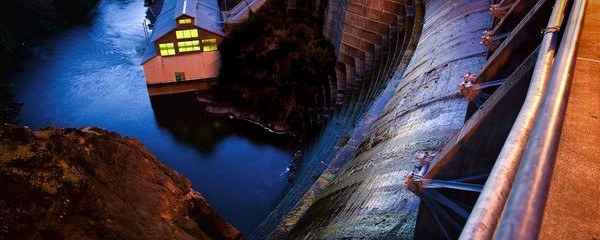
To quench my energy and politics needs, I was enrolled in Public Policy with Ellen Seljan. I was taking environmental geology with Liz Safran and her teaching style and enthusiasm led me to environmental hydrology a semester later. During all of this, I was applying for my first research grant and had to come up with a research topic. Hydrology, water, energy…DAMS! I began to look and hydroelectric dams and the controversies surrounding them, specifically, hydroelectric dam deconstruction. At this point, I came back to the individual and the ability of the individual (groups) to enact large-scale change. My research questions were as follows: “How is local policy constructed? How do governmental and nongovernmental entities cooperate to make policy for watersheds in the Pacific Northwest? What is the role of interest groups, lawyers, scientists and the community at large?” and “Is it feasible to consider deconstruction of dams in the Pacific Northwest in light of regional climate and desire for more alternative power sources? What are the implications?” Less big. But still big.
My junior year I took an environmental theory class from Jim Proctor. It was really eye-opening and I am still processing topics that we just scratched the surface of throughout the semester. I used my knowledge from my dam research to go deep and came out with the following as far as my thesis research goes: “How do facts get transformed to give science volatility?” As of now, my case study surrounds the deconstruction of four hydroelectric dams on the Klamath River that runs from Oregon to California. I am thinking of focusing in on a specific fact and attempting to really uncover its origin story and its effect on proceedings in the basin as a whole. I am no longer fixated on the role of the individual, but more on the citizen groups, policy makers, and scientific communities that play a role in making decisions like these. My analysis will be grounded in Systematic Environmental Theory, if that is a thing that can be done.
I guess we’ll see.
Leave a Reply