• About
    • This Site & ENVS
    • ENVS Site Navigation
  • Communications
    • Communications Archives
      • ENVS Announcements Archive
      • ENVS Alum Email Archive
      • ENVX Newsletter Archive
    • Contact ENVS/DS SAAB Tutors
    • Instagram Feed
    • Make an Appointment
    • Nominate Your Post/Project/Site
    • Opportunities Posts
    • Poster Design
    • Share/Read/Display DS Site Post RSS Feeds
  • Major/Minor Info
    • The ENVS Major & Minor
    • ENVS Core Courses
    • ENVS 244/295/499
    • Future Courses
    • Your Student Record
    • Your Concentration
    • Your Projects
    • Your Senior Capstone
    • Related PSU/PCC Courses
  • Course Resources
    • Doing Situated Research
      • Situated Research Details
    • ENVS Course & Project Portfolio Templates
      • Course Portfolio Template
      • Project Portfolio Template
    • ENVS Records: Scoring Rubrics
    • Interdisciplinarity and Concept Mapping
    • Mapping Actors & Processes
    • Models of Environmental Communication
    • New York Times Environment Articles
    • Resources for ENVS Topics
      • ENVS Topics Glossary
    • Share Spatial Data
    • Style Reminders for ENVS Students
    • Styling Citations via Chicago Author-Date
  • Databases
    • About Student Databases
    • ENVS Students
    • ENVS Concentrations
    • Senior Capstones
    • Student Projects
    • Map of All Projects
  • Other Sites
    • ENVS LC Site ➤
      • Events
      • News
      • Symposium
    • Bridges (ENVS 295)
    • DS Multisite Home ➤
      • DS Help Site
      • DS Training Site
    • EcoTypes Site
    • Environmental Action LLC Site
    • ENVS 160 SP18 (Login Only)
    • ENVS Facebook Page
    • ENVX Site
    • Overseas Site

ENVS Program

Lewis & Clark Environmental Studies

November 12, 2014 9:41 am

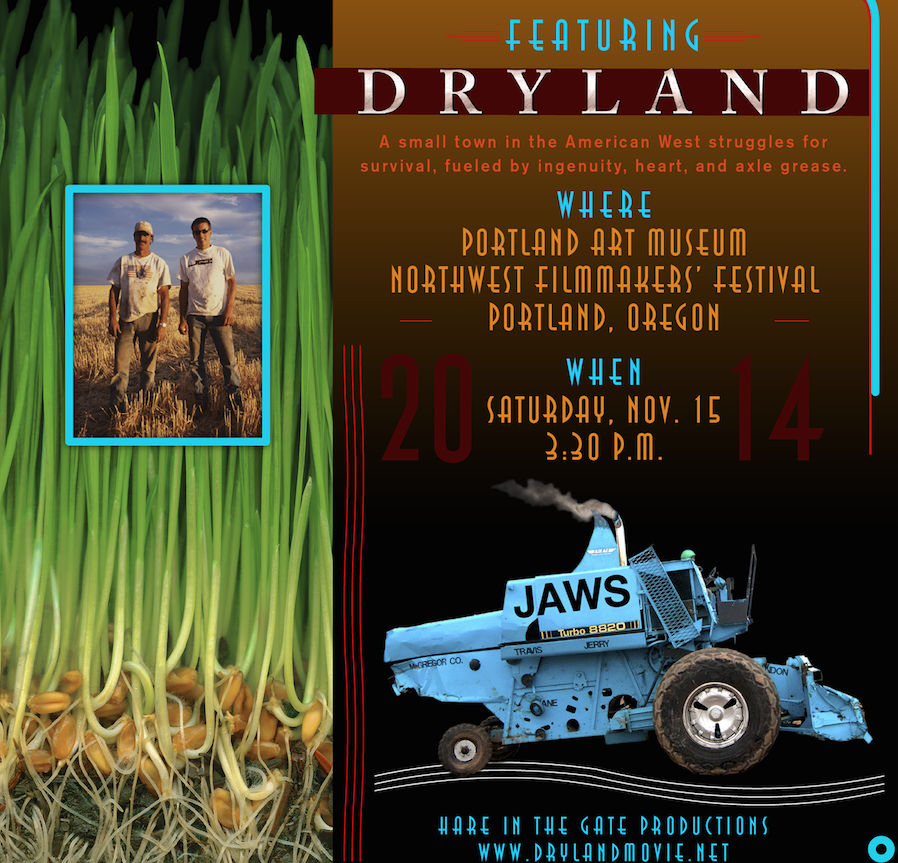
DRYLAND Documentary Screening Nov. 15th

DrylandReduced

DRYLAND documentary makes its Portland premiere

as an Official Selection of the 41st Northwest Filmmakers’ Festival.

A small town in the American West struggles for survival,fueled 

by ingenuity, heart…and axle grease.


PORTLAND, OREGON, NOVEMBER 3, 2014—Dryland is an intimate portrait of rural America in transition, through the eyes of a young man pursuing his dream and a town fighting to survive. The 62-minute film will screen in Portland, Saturday, November 15, at 3:30 p.m. at the Northwest Film Center’s Whitsell Auditorium, inside the Portland Art Museum, as part of the 41st Northwest Filmmakers’ Festival. The screening directly follows a composer’s workshop, hosted by the Northwest Filmmakers’ Festival, offered by award-winning Drylandcomposer Mark Orton (Nebraska, My Old Lady.) The directors, Sue Arbuthnot and Richard Wilhelm, who received an Oregon Arts Commission Media Arts Fellowship for Dryland, and the film’s two lead cast members, will be present to answer questions after the screening.


The film’s mission is to spark fresh conversation about the need to preserve family farms and reinvigorate local towns, while bridging gaps in understanding between urban and rural Americans, keen to participate in a truly sustainable future for agriculture. A recent panel discussion, “Finding a Common Language: Farming in Rural and Urban Communities,”included Professor Gigi Berardi, with Western Washington University’s Department of Environmental Studies, and Debbie VanderVeen, Whatcom County Farm Bureau President.


Told over ten years, Dryland allows rare access into the desires and obstacles experienced by those who grow our food—now just 1% of Americans. While Josh Knodel yearns to remain on his 4th generation Eastern Washington wheat farm, forces of advancing technology, global economics, and an ever-increasingly extreme climate bear down on family farms around the country and the world.


But farmers rarely take no for an answer. Battling rural decline, the tiny town of Lind stages an annual combine demolition derby, in a boisterous, quirky feat to preserve the region’s agricultural heritage. Metal-grinding, exuberant fun, these hulking out-of-retirement wheat combines duel with the same “get-‘er-done” fortitude keeping struggling towns and family farms afloat.


Josh, 18, aided by best friend Matt Miller, 17, is as passionate about winning the derby as he is about farming. But even though their combine, JAWS, often takes the title, Josh’s dream shatters when he learns he must leave home to find a job. Ultimately, through persistence and hard work, his family is able to bring him home and continue the family’s legacy.


Called “a bittersweet and beautiful new film” by Modern Farmermagazine and “moving” by Grist, Dryland plays a cinematic duet between a freewheeling spectacle and a wistful meditation on our changing heartland. Contrasting the measured cadences of rural life with the upbeat pace of the contest, the film’s rhythms are poignantly scored by Mark Orton, who recently scored the Oscar-nominated Nebraska. A donated song by John Mellencamp, and a song by Don Walser round out the soundtrack.


Awarded Best Feature Documentary at the 2014 Ellensburg Film Festival, Dryland premiered in February 2014 at the Big Sky Documentary Film Festival in Missoula, and has been selected to screen in festivals in Ohio, Oregon, Iowa, Washington, and Utah, and recently screened in New Zealand. A “Grass Routes” screening tour under the banner of Cultivating Rural Resilience has begun, uniting diverse audiences in a movement to reinvigorate rural communities and support sustainable agriculture.


“Dryland is a both a raucous celebration of the culture of agriculture and an honest look at the reality of family farming…whether the family farm can sustain the next generation is a question faced all over this country and one that is crucial to the future of the food system and our nation. Dryland is a fantastic story of farming, family, community and hope!”

—Jennifer Fahy, Farm Aid


“Dryland does a remarkable job of capturing the heart and soul of two wheat farming families in eastern Washington, displaying their passion for farming and their commitment to maintaining their way of life. It provides an excellent opportunity for those of us not living on a farm to see firsthand what it takes to be a successful farmer in today’s economy.”

—Tom Davis, Washington Farm Bureau


High-resolution stills available upon request. Samples here.


About Hare in the Gate, LLC

Based in Portland, Oregon, Sue Arbuthnot and Richard Wilhelm formed Hare in the Gate Productions in 1999, creating award-winning documentaries exploring such topics as affordable urban housing, Native American history, and portraying world-renowned artists. Their work aims to forge connections and deepen our understanding of a complex world. Splitting time between Portland and rural southeast Oregon, both partners maintain close ties with rural life and a deep interest in the viability of the family farm. More information can be found at www.hareinthegate.com, or join the Dryland conversation on Twitter and Facebook.

Related

Filed Under: Education Opportunities, Off-campus, Opportunities

Opportunities Post Categories

  • Opportunities (520)
    • Education Opportunities (205)
    • Funding Opportunities (54)
    • Internship Opportunities (91)
    • Job Opportunities (114)
    • Off-campus (245)
    • On-campus (99)
    • Study Abroad Opportunities (25)
    • Volunteer Opportunities (53)
  • Post (23)

Recent ENVS Posts

Who is she?: Gaia and other Big Words
16th May 18By KT Kelly
Prioritization of Conservation: Intersections of the Peruvian Amazon and the Andean Mountain Range
8th May 18By Jon Hosch
Capstone 3
5th May 18By Alannah Balfour
Capstone #2
5th May 18By Alannah Balfour
Capstone #1
5th May 18By Alannah Balfour
Kokuritsukouen: The Past and Future of Japan’s National Parks
4th May 18By Rachel Aragaki
Investigating Climate Change: Understanding the Effects of Increasing Sea Surface Temperature (SST) on Arctic Fish Populations
3rd May 18By Marissa Weileder
Analyzing Anthropogenic Influence: A Look into How Humans Have Shaped the Perceptions of Climate Change
3rd May 18By Marissa Weileder
Freshwater & Fish: A Case Study of the Effects of Melting Permafrost on Arctic Freshwater Species
3rd May 18By Marissa Weileder
If You Die in the Game, You Die in Real Life: Video Game Environments and Disaster Preparedness
3rd May 18By Rachel Aragaki
Knickpoint Retreat and Stream Channel Morphology in the Columbia River Gorge
3rd May 18By Shawn Bolker
Barriers to Justice: Environmental Litigation in Hawaii
3rd May 18By Kassie Kometani
Satoyama Services: Historical versus Modern Roles of Japan’s Hybridized Landscapes
3rd May 18By Rachel Aragaki
Development Indicators for Fostering Development in Cambodia
3rd May 18By Nick Sievers
Building Flood Resilience in Urban Australia
3rd May 18By Curtis Hall
Choosing Direct Trade: Combating Vulnerability of Smallholding Coffee Farmers
3rd May 18By Evan Howell
Home-Based Water Recycling in Urban Australia
3rd May 18By Curtis Hall
The Sinking of Christchurch: Increased Flood Vulnerability after the 2011 Christchurch Earthquake
3rd May 18By Curtis Hall
Implications of a Growing Middle Class and Increased Consumption Patterns in India
3rd May 18By Nick Sievers
Alleviating Marginalization with Your Wallet: Investigating Fair Trade Coffee Consumer Behavior in Portland, Oregon
3rd May 18By Evan Howell
Religious Pilgrimage and Tourism on Mt. Fuji, Japan
3rd May 18By Shawn Bolker
Situating National Environmental Policies Within a Global Market (Proposal 3)
3rd May 18By Jonas Miller-Stockie
Using Trees to Alleviate the Coffee Crisis: Investigating Farmers’ Knowledge of Ecosystem Services in Veracruz, Mexico
3rd May 18By Evan Howell
Energy Security in South Korea: Methods of Reducing Foreign Fossil-Fuel Dependency
3rd May 18By Nick Sievers
Capstone Proposal #3: The Role Of Environmental Lobbying Firms Towards Progress In Environmental Policy In the U.S.
3rd May 18By Sabrina Cerquera
How the American People Conserve Energy: Can they Do Better?
3rd May 18By Jack Kamysz
Mediation of Climate Change in the U.S.
3rd May 18By Jack Kamysz
Assessing the Impacts of Waterfall Tourism in the Columbia River Gorge
3rd May 18By Shawn Bolker
Violence in Colombia: Illegal Gold Mining Leaves Indigenous Colombians at Risk
3rd May 18By Grace Boyd
The Interactions between hard and soft law in the Comprehensive Nuclear Test Ban Treaty
3rd May 18By Jack Kamysz

Digital Scholarship Multisite © 2018 · Lewis & Clark College · Environmental Studies Program · Log in