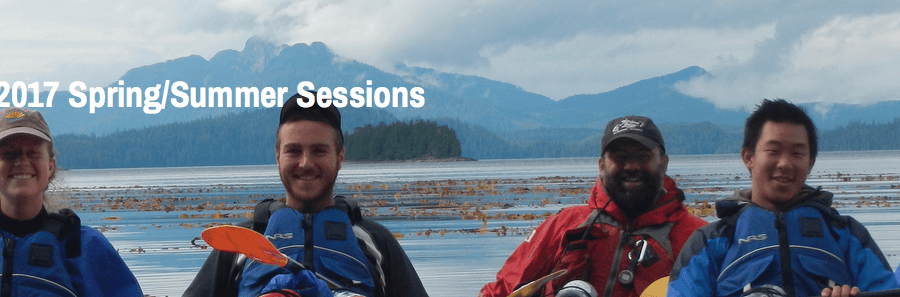
*Apply now – Scholarships available*
The Tatoosh School is a nonprofit, university-level field school with a beachfront base camp on Prince of Wales Island and lecture halls in the towns, oceans, and forests of Alaska’s Inside Passage. It is the school’s mission to foster first-hand learning about the ecology and environmental policy of southern Southeast Alaska.
Rigorous academics focus on the development of a sense of place, a passion for civic engagement and a sound knowledge of the Pacific coastal ecoregion. You can earn up to 12 units of credit and leave empowered to explore your surroundings with wide-eyed curiosity and to reach out as an active and informed citizen. Innovative curriculum teaches scientific curiosity and research methods in ways that you can take home and practice, building a field course into a lifelong passion for wild learning.
Tatoosh School students become field scientists and participate in several long-term ecological research programs in collaboration with our partners. Gain invaluable experience and professional connections that can last a lifetime. Take advantage of the opportunity to apply understandings of Southeast’s dynamic terrestrial, riparian, and nearshore marine ecosystems while compiling a data set that supports land managers in their evaluation of the efficacy of restoration techniques as projects progress across the region.
—–
3-week Intensive I: May 16 – June 7, 2016
Community Ecology: Salmon, People, Place
This 3-week intensive focuses on the communities that inhabit the heart of the Pacific Coastal Ecoregion. Conceived broadly, the course theme of community ecology launches explorations from the outer coast to the Inside Passage to study interactions at varying scales and across biological, social, biophysical, and cultural boundaries.
Course description: Students develop an understanding of key ecological principals of aquatic and terrestrial systems, from the nearshore intertidal zone to the high alpine. This class also examines the adaptations and relationships of organisms to their environments over time and space. A community ecology lens adds consideration of organizations and networks on the landscape and in human communities, enhancing students’ knowledge of resiliency and sustainability in the ecoregion. (4 semester or 6 quarter units, 410/510)
—–
6-week Summer Session: June 15 – July 28, 2016
Core Session
The Core Session expedition includes two upper-division classes taken concurrently, one in ecology and a second in natural resource policy.
Aquatic & Terrestrial Ecology of Southeast Alaska (4 semester or 6 quarter units). Students develop an understanding of key ecological principals of aquatic and terrestrial systems, from the nearshore intertidal zone to the high alpine. This class also examines the adaptations and relationships of organisms to their environments over time and space.
Politics of Place: Southeast Alaska (4 semester or 6 quarter units). Topics include land ownership, public and private land management, conservation strategies, local and regional economies, Alaska Native cultures and communities, and contemporary resource management issues. A focus is placed on the evolution of social and legal structures, and how these structures guide current decision-making. Inquiry and reason are applied to real-life challenges, and students engage with citizens and policymakers to consider solutions.
—–
3-week Intensive II: August 2 – August 24, 2016
Karta River Wilderness
The Karta River Wilderness sits in the center of Prince of Wales Island, the heart of southern Southeast Alaska. Home to salmon, eagles, bears, deer, wolves, ancient shorelines, and a pre-Wilderness history of fire, mining, and fishing, the Karta has been inhabited since time immemorial. Designated a Wilderness by the Tongass Timber Reform Act in 1990, the watershed supports a subsistence sockeye fishery and serves as a corridor and home range for wildlife. The Karta River Wilderness course will begin with a 4-day Island orientation in preparation for a 10-12 day Wilderness backcountry expedition. Traveling to the Karta estuary by sea kayak, students will switch to backpacks for upland hiking and field research work.
Course description: Course topics include riparian and forest ecology, salmon biology, paleoshorelines and archaeology, geomorphology, Alaska Native culture and history, and public lands policy. Students develop an understanding of key ecological principals of aquatic and terrestrial systems, from the nearshore intertidal zone to the high alpine. This class also examines the adaptations and relationships of organisms to their environments over time and space. (4 semester or 6 quarter units, 410/510)
—–
3-week Intensive III: August 29 – September 19, 2015
Stewardship of Salmon Rivers
With 990 miles of coastline, thriving runs of wild salmon, and strong communities that depend on the forest and sea around them, Prince of Wales Island is a lecture hall like no other. Multiple-use forest management has affected the integrity of salmon-bearing streams in Southeastern Alaska, and the effects of a dynamic climate are playing out each year. Local land managers, nonprofit partners, Alaska Native communities, businesses and citizens are actively working to care for the salmon landscape. While many river systems on the Island are relatively intact, the time to learn about – and engage in – integrative stewardship of salmon rivers is now.
Course description: This intensive course examines the physical, biological, economic and political frameworks essential to informed stewardship of salmon-producing watersheds in the Pacific Coastal Ecoregion. Coursework engages the fields of hydrology, geology, geomorphology, biology, political science, and economics to develop students’ understanding of integrated watershed stewardship. Students practice stream survey and monitoring techniques that contribute to long-term collaborative stewardship work while gaining valuable field research experience. (4 semester or 6 quarter units, 410/510)
Learn more and apply at http://tatooshschool.org
Questions? peter@tatooshschool.org or 503.347.2599
Like us on Facebook for the latest updates, videos & photos http://facebook.com/tatooshschool