
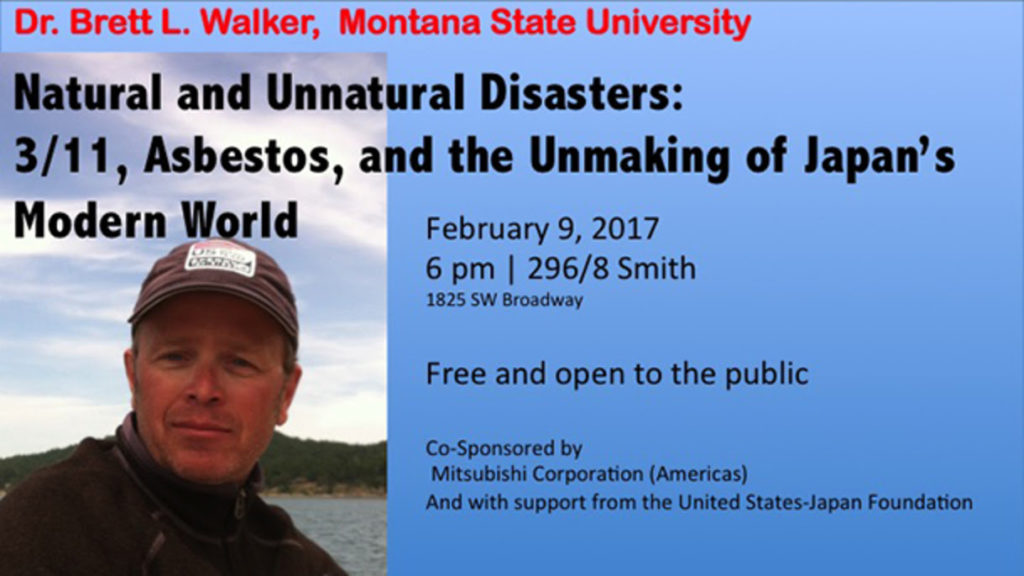
The March 11, 2011 massive earthquake in northeastern Japan left an estimated 25 millions tons of rubble, much of it contaminated with asbestos and other carcinogenic toxins. When the tides of the devastating tsunami ebbed, the unnatural disaster of cleaning up Japan’s pulverized and aerosolized built environment remained. Now, every time a backhoe or shovel digs into this rubble, asbestos fibers are released into the environment to threaten human health.
Asbestos was a critical fiber in the construction of Japan’s modern built environment because of the culturally engrained fear of fire. Unlike many other industrialized countries, Japan has had large cities since the late sixteenth century, as well as the accompanying catastrophes of massive urban conflagrations.
Dr. Walker investigates asbestos in the construction and, more importantly, destruction of Japan’s built environment, with a focus on the impact of the 3/11 disaster and the later clean up.
PSU History Department Alumnus
Brett L. Walker is Regents Professor of History at Montana State University, Bozeman. His research and teaching interests include Japanese history, world environmental history, and the history of science and medicine. He is author of The Conquest of Ainu Lands: Ecology and Culture in Japanese Expansion, 1590-1800, The Lost Wolves of Japan, Toxic Archipelago: A History of Industrial Disease in Japan, and A Concise History of Japan, from Cambridge University Press.