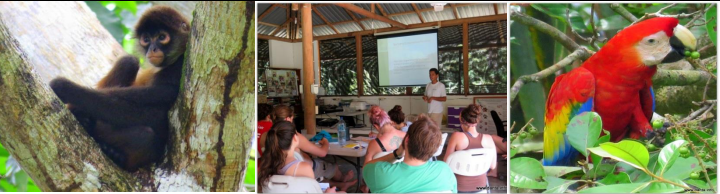
| Do you have an interest in wildlife, tropical ecology and/or conservation? Are you looking to gain valuable field experience? Would you like to learn about other cultures? Would you like to learn more about yourself? If so, consider applying to DANTA’s 2007 field courses in tropical biology. DANTA’s courses are intended for undergraduates or early graduate level students who have a keen interest in tropical ecosystems and conservation, but have little or no experience of working in a tropical environment. Participants may enroll on either a credit or non-credit basis. Visit the DANTA website and blog to learn more about the upcoming courses. Below lists upcoming courses happening in summer 2017.
Methods in Primate Behavior and Conservation Dates: July 15 – July 30, 2017 Program Fee: $2500 Application deadline: Summer Session: June 1, 2017 Course Description This course is designed to provide students with field experience in primate behavior, ecology, and conservation. This course will be held at Osa Conservation’s Piro Reseach Station in Costa Rica’s spectacular Osa peninsula. As the one of the largest tracts of rain forest north of the Amazon (roughly 400,000 acres in the Osa Conservation Area), it is renowned for high species diversity. It is one of only a few places in Costa Rica that has jaguar, puma, sea turtles and four species of monkey (mantled howler monkey, black-handed spider monkey, white-faced capuchin and squirrel monkey). The learning experiences for the course fall into four main categories: field exercises, seminars, lectures, and applied conservation. The field exercises and seminars provide instruction and experience in: (1) methods of measuring environmental variables, including assessment of resource availability, (2) methods of collecting and analyzing the behavior of free-ranging primates, (3) assessments of biodiversity and (4) techniques for estimating population size. Lecture topics will cover the behavior and ecology of Old and New World primates from an evolutionary perspective. Selected lecture topics include primate sociality, feeding ecology, taxonomy, rain forest ecosystems and conservation. Service learning is a large component of all our programs. Students will gain experience in applied conservation through participation in Osa Conservation’s reforestation, sustainable agriculture and wildlife monitoring programs (big cat and sea turtle). During the course participants will visit a wildlife rehabilitation center, sustainable chocolate plantation, and take a boat tour of the Golfo Dulce for dolphin viewing and snorkeling. We overnight on the Boruca Indigenous Reserve where we will learn about the community and their traditional lifeways, and help with needed projects. All within country travel is in cooperation with Planet Conservation, our sustainable travel partner. Every effort is made to implement eco-friendly and socially responsible practices into our day-to-day operations, field courses and overall mission. Enrollment is limited to 15 students. The course is open to both credit and non-credit seeking students. University credit can be arranged through your home institution. Primate Behavior and Conservation Dates: June 15-July 10, 2017 Program Fee: $3500 Application deadline: May 15, 2017 Course Description This course is designed to provide students with field experience in primate behavior, ecology, and conservation. The course will be conducted at Osa Conservation‘s Piro Research Station in Costa Rica’s spectacular Osa peninsula. As the one of the largest tracts of rain forest north of the Amazon (roughly 400,000 acres in the Osa Conservation Area), it is renowned for high species diversity. It is one of only a few sites in Costa Rica that contain 4 species of primate (mantled howler monkey, black-handed spider monkey, white-faced capuchin and squirrel monkey). Four species of sea turtle also nest along its beaches. Please help us protect this unique region which is of international conservation concern. The learning experiences for the course fall into five main categories: field exercises, independent research, discussions, lectures and applied conservation. The first half of the courses is devoted to learning ecological field techniques, while in the second half students develop, carry out and present data from their independent research projects. Many of our participants have gone on to present their work at national and regional conferences. The field exercises and seminars provide instruction and experience in:(1) methods of measuring environmental variables, including assessment of resource availability, (2) methods of collecting and analyzing the behavior of free-ranging primates, (3) assessments of biodiversity and (4) techniques for estimating population size. Lecture topics will cover the behavior and ecology of Old and New World primates from an evolutionary perspective. Selected lecture topics include primate sociality, feeding ecology, taxonomy, rain forest ecosystems, conservation, climate change and sustainability. Participants gain experience in applied conservation through participation in Osa Conservation’s reforestation,and sea turtle breeding and monitoring programs. During the course participants will visit a wildlife rehabilitation center, sustainable chocolate plantation, and take a boat tour of the Golfo Dulce for dolphin viewing and snorkeling. We overnight on the Boruca Indigenous Reserve where we will learn about the community and their traditional lifeways, and help with needed projects. All within country travel is in cooperation with Planet Conservation, our sustainable travel partner. Every effort is made to implement eco-friendly and socially responsible practices into our day-to-day operations, field courses and overall mission. Enrollment is limited to 15 students. The course is open to both credit and non-credit seeking students. University credit can be arranged through your home institution. Birds of Costa Rica Dates: July 15 – July 30, 2017 Program Fee: $2500 Application Deadline: June 1, 2017 Course Description Costa Rica is justly renowned for its extraordinary bird diversity, and for the depth of study that has focused on the life histories of these delightful animals, often so social, colorful and full of song. We will take advantage of these highlights, with a course designed around the ecology and behavior of some of Costa Rica’s most easily seen (and heard) birds, and the biologists who have studied them. Knowing the history of bird studies in Costa Rica will help us understand these birds more fully, and will also let us see how growth in knowledge of their biology was linked to the vibrant conservation movement that has helped to define this country. We will base our studies at the remote but comfortable Piro Research Station on Costa Rica’s spectacular Osa Peninsula, home to some of Central America’s last remaining primary forest and its wildest beaches. Our Piro studies will focus on four key topics: 1. Learning to identify birds by sight and sound. While no one can expect to learn all of Costa Rica’s birds in 2 weeks, students will become familiar with the most common species found on the Osa in early January, at the start of the dry season; 2. Methods of collecting and analyzing the behavior of free-ranging birds. Here we will focus on birds easily seen, designing short but focused studies on such topics as foraging, habitat choice, interactions within flocks, and song (we will have access to basic equipment for recording and analyzing song). 3. Patterns of species diversity: here we will look broadly, and from an ecological and evolutionary perspective, at what kinds of birds are found in Costa Rica. Why, for example, are there dozen of species of hummingbirds and flycatchers, but far fewer parrots, pigeons and quail? 4. Key studies of Costa Rican birds: some of the giants in American ornithology have spent their careers researching Costa Rican birds. We will pick highlights from these studies, gaining an understanding not only of how ornithology is done, but also of what topics emerged from these studies and how they helped shape conservation in Costa Rica. Students are welcomed from all walks of biology, but a background in biology is not a prerequisite; key is a keen desire to learn more about Costa Rican birds and ornithology. Physical demands in this course are modest but real; students can expect to walk 2-3 kilometers/day, occasionally in uncomfortable weather (heat, rain). Good binoculars are key to studying birds: students are encouraged to bring their own, but a few loaner pairs will be available to those who don’t have them. During the course participants will visit a wildlife rehabilitation center, sustainable chocolate plantation, and take a boat tour of the Golfo Dulce for dolphin viewing and snorkeling. We overnight on the Boruca Indigenous Reserve where we will learn about the community and their traditional lifeways, and help with needed projects. All within country travel is in cooperation with Planet Conservation, our sustainable travel partner. Every effort is made to implement eco-friendly and socially responsible practices into our day-to-day operations, field courses and overall mission. Enrollment is limited to 15 students. The course is open to both credit and non-credit seeking students. University credit can be arranged through your home institution. Wildlife Conservation and Sustainability Dates: August 2-17, 2017 Program fee: $2500 Application deadline: June 1, 2017 Course Description The proximate and ultimate causes of declines of rain forest habitats and biodiversity will be examined through a combination of direct observations in the field, lectures, and critical reviews of the literature. Topics will include the role of hunting, logging, agriculture, disease, predation, expanding human populations and their consumption of natural resources as they affect forest and biodiversity conservation. Emphasis will be on sustainable solutions and how today’s human societies can endure in the face of climate change, ecosystem degradation and resource limitations. The majority of the course will be conducted at Osa Conservation‘s Piro Research Station in Costa Rica’s spectacular Osa Peninsula. As one of the largest tracts of rain forest north of the Amazon (roughly 400,000 acres in the Osa Conservation Area), it is renowned for high species diversity. It is one of only a few sites in Costa Rica that contain 4 species of primate (mantled howler monkey, black-handed spider monkey, white-faced capuchin and the Central American squirrel monkey). Four species of sea turtle also nest along its beaches. Students gain hands-on experience through participation in Osa Conservation’s sustainable agriculture, wildlife monitoring and reforestation programs. Problems of various land-use activities will be evaluated with side trips to an oil palm plantation, a coffee plantation, and small-scale agricultural plots. During the course participants will visit a wildlife rehabilitation center, sustainable chocolate plantation, and take a boat tour of the Golfo Dulce for dolphin viewing and snorkeling. We overnight on the Boruca Indigenous Reserve where we will learn about the community and their traditional lifeways, and help with needed projects. All within country travel is in cooperation with Planet Conservation, our sustainable travel partner. Every effort is made to implement eco-friendly and socially responsible practices into our day-to-day operations, field courses and overall mission. Enrollment is limited to 15 students. The course is open to both credit and non-credit seeking students. University credit can be arranged through your home institution. |