• About
    • This Site & ENVS
    • ENVS Site Navigation
  • Communications
    • Communications Archives
      • ENVS Announcements Archive
      • ENVS Alum Email Archive
      • ENVX Newsletter Archive
    • Contact ENVS/DS SAAB Tutors
    • Instagram Feed
    • Make an Appointment
    • Nominate Your Post/Project/Site
    • Opportunities Posts
    • Poster Design
    • Share/Read/Display DS Site Post RSS Feeds
  • Major/Minor Info
    • The ENVS Major & Minor
    • ENVS Core Courses
    • ENVS 244/295/499
    • Future Courses
    • Your Student Record
    • Your Concentration
    • Your Projects
    • Your Senior Capstone
    • Related PSU/PCC Courses
  • Course Resources
    • Doing Situated Research
      • Situated Research Details
    • ENVS Course & Project Portfolio Templates
      • Course Portfolio Template
      • Project Portfolio Template
    • ENVS Records: Scoring Rubrics
    • Interdisciplinarity and Concept Mapping
    • Mapping Actors & Processes
    • Models of Environmental Communication
    • New York Times Environment Articles
    • Resources for ENVS Topics
      • ENVS Topics Glossary
    • Share Spatial Data
    • Style Reminders for ENVS Students
    • Styling Citations via Chicago Author-Date
  • Databases
    • About Student Databases
    • ENVS Students
    • ENVS Concentrations
    • Senior Capstones
    • Student Projects
    • Map of All Projects
  • Other Sites
    • ENVS LC Site ➤
      • Events
      • News
      • Symposium
    • Bridges (ENVS 295)
    • DS Multisite Home ➤
      • DS Help Site
      • DS Training Site
    • EcoTypes Site
    • Environmental Action LLC Site
    • ENVS 160 SP18 (Login Only)
    • ENVS Facebook Page
    • ENVX Site
    • Overseas Site

ENVS Program

Lewis & Clark Environmental Studies

Doing Situated Research

Overview

Good research could go a long way toward successfully addressing environmental issues. But what is good environmental research? In ENVS, we offer a particular answer: get situated! Situated research brings environmental issues into a geographical lens, examining a wide range of processes and perspectives at multiple temporal and spatial scales as they converge at a particular location, region, or network of locations.

Situated research, in short, grounds interdisciplinary environmental research in a real-world context. It helps bring big, often abstract environmental issues down to earth, in a manner open to their full complexity while offering focus. Effective fall 2017, we have a new draft diagram and scoring rubric (below) to help you do high-quality, interdisciplinary situated environmental research.

Read on!…but remember that there are lots of details associated with situated research: make sure to read them here.

Situated Research Diagram

Situated research is a process. Think of it as starting from the top of the hourglass below, then proceeding to the middle and the bottom—situated research involves zooming in and out. At each step, there are particular things you do, summarized by this diagram. Study the diagram, then consult the scoring rubric below for each component, and read details here.
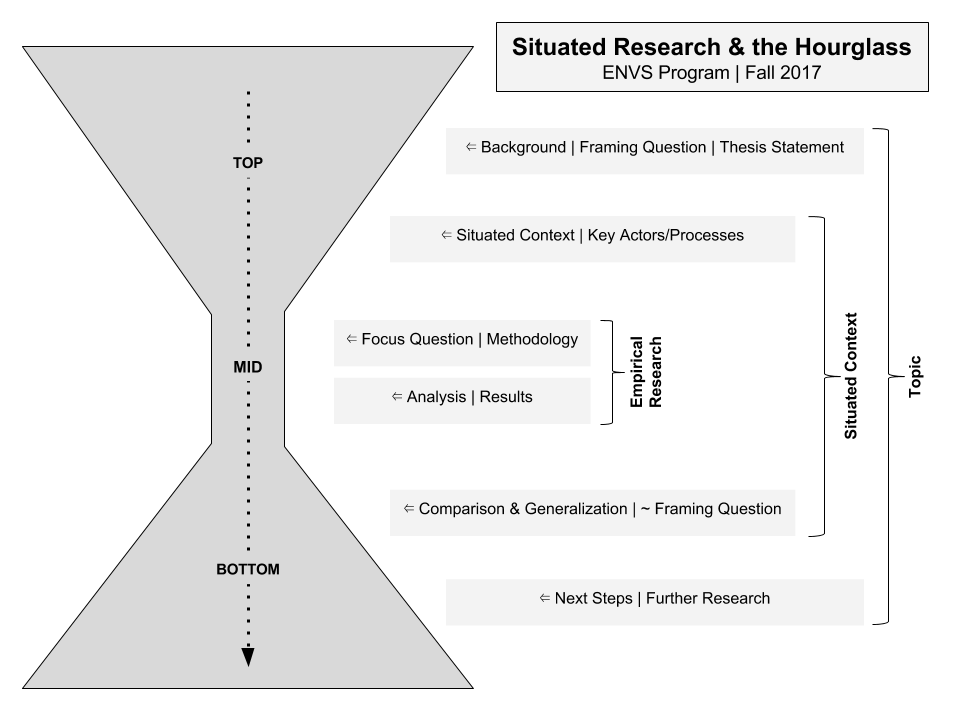
Situated Research Rubric

Here is a scoring rubric we are testing along with the above diagram in fall 2017. To assign scores, read each component element below (six total), then decide which of the below applies (30 points possible):

  • 5 = All elements
  • 4 = Many elements
  • 3 = Some elements
  • 2 = Fewer elements
  • 1 = Very few elements

To download the entire scoring rubric with the hourglass diagram so that you can print it and score a situated research project, click here.

HourglassComponentElements Required for Full Credit
TopBackground | Framing Question | Thesis StatementComprehensive, relevant, readable background to research topic, building on and weaving together related scholarly and popular discussions; introduction and justification of broad, significant, understandable framing question(s) emanating from this background; and clear, argumentative thesis statement building on this background and summarizing entire hourglass process below, offering provisional answer to focus question(s) and important perspective on framing question(s).
TopSituated Context | Key Actors/ProcessesClear and compelling introduction (with map) of geographical context(s) for research on topic, including vertical (general type) and lateral (comparative) justification; broad overview (including text and concept map) clarifying, and specifying relations between, key actors/processes in chosen context(s), and their potential relevance to topic and framing question(s).
MiddleFocus Question | MethodologyClear summary and justification of empirical research focus question(s) to be answered for topic in situated context(s), including relevance to framing question(s) and doability in given context(s); step by step summary of each methodological element by which focus question(s) to be answered, with justification (including related studies) of each methodological element as well as data sources, ethical concerns if applicable, and other considerations.
MiddleAnalysis | ResultsStep by step procedure of analysis as above methodology implemented, including changes in response to research challenges; specific results, in narrative, chart, and table format as appropriate, obtained from analysis of each methodological element, with clear and direct reference to how these results answer focus question(s).
BottomComparison & Generalization | Relevance to Framing QuestionClear and defensible broadening of results, starting with summary for focus question(s) in given context(s), then (lateral) comparison to other (similar or different) situated contexts based on existing literature and/or reasoned guess, as well as (vertical) generalization of possible larger patterns relevant to topic; clear and provocative application of specific results and larger comparison/generalization to shed fresh and important light on topic framing question(s).
BottomNext Steps | Further ResearchUnderstandable and compelling application of entire hourglass argument above to derive next steps for consideration or action on chosen topic, including practical/policy options, potentially with reference—but not limited—to chosen situated context(s); clear and doable recommendations for further research building on (or perhaps deviating from) this situated research project.


Recent ENVS Posts

Who is she?: Gaia and other Big Words
16th May 18By KT Kelly
Prioritization of Conservation: Intersections of the Peruvian Amazon and the Andean Mountain Range
8th May 18By Jon Hosch
Capstone 3
5th May 18By Alannah Balfour
Capstone #2
5th May 18By Alannah Balfour
Capstone #1
5th May 18By Alannah Balfour
Kokuritsukouen: The Past and Future of Japan’s National Parks
4th May 18By Rachel Aragaki
Investigating Climate Change: Understanding the Effects of Increasing Sea Surface Temperature (SST) on Arctic Fish Populations
3rd May 18By Marissa Weileder
Analyzing Anthropogenic Influence: A Look into How Humans Have Shaped the Perceptions of Climate Change
3rd May 18By Marissa Weileder
Freshwater & Fish: A Case Study of the Effects of Melting Permafrost on Arctic Freshwater Species
3rd May 18By Marissa Weileder
If You Die in the Game, You Die in Real Life: Video Game Environments and Disaster Preparedness
3rd May 18By Rachel Aragaki
Knickpoint Retreat and Stream Channel Morphology in the Columbia River Gorge
3rd May 18By Shawn Bolker
Barriers to Justice: Environmental Litigation in Hawaii
3rd May 18By Kassie Kometani
Satoyama Services: Historical versus Modern Roles of Japan’s Hybridized Landscapes
3rd May 18By Rachel Aragaki
Development Indicators for Fostering Development in Cambodia
3rd May 18By Nick Sievers
Building Flood Resilience in Urban Australia
3rd May 18By Curtis Hall
Choosing Direct Trade: Combating Vulnerability of Smallholding Coffee Farmers
3rd May 18By Evan Howell
Home-Based Water Recycling in Urban Australia
3rd May 18By Curtis Hall
The Sinking of Christchurch: Increased Flood Vulnerability after the 2011 Christchurch Earthquake
3rd May 18By Curtis Hall
Implications of a Growing Middle Class and Increased Consumption Patterns in India
3rd May 18By Nick Sievers
Alleviating Marginalization with Your Wallet: Investigating Fair Trade Coffee Consumer Behavior in Portland, Oregon
3rd May 18By Evan Howell
Religious Pilgrimage and Tourism on Mt. Fuji, Japan
3rd May 18By Shawn Bolker
Situating National Environmental Policies Within a Global Market (Proposal 3)
3rd May 18By Jonas Miller-Stockie
Using Trees to Alleviate the Coffee Crisis: Investigating Farmers’ Knowledge of Ecosystem Services in Veracruz, Mexico
3rd May 18By Evan Howell
Energy Security in South Korea: Methods of Reducing Foreign Fossil-Fuel Dependency
3rd May 18By Nick Sievers
Capstone Proposal #3: The Role Of Environmental Lobbying Firms Towards Progress In Environmental Policy In the U.S.
3rd May 18By Sabrina Cerquera
How the American People Conserve Energy: Can they Do Better?
3rd May 18By Jack Kamysz
Mediation of Climate Change in the U.S.
3rd May 18By Jack Kamysz
Assessing the Impacts of Waterfall Tourism in the Columbia River Gorge
3rd May 18By Shawn Bolker
Violence in Colombia: Illegal Gold Mining Leaves Indigenous Colombians at Risk
3rd May 18By Grace Boyd
The Interactions between hard and soft law in the Comprehensive Nuclear Test Ban Treaty
3rd May 18By Jack Kamysz

Recent Opportunity Posts

Eco Practicum Catskills – application deadline extension

Eco Practicum Catskills – application deadline extension

May 2, 2018

Actionable Climate Science Skills-Building Webinar Series

Actionable Climate Science Skills-Building Webinar Series

April 26, 2018

Lewis and Clark Summer Geospatial Project Assistant Student Position

Lewis and Clark Summer Geospatial Project Assistant Student Position

April 26, 2018

More Opportunity Posts

Digital Scholarship Multisite © 2018 · Lewis & Clark College · Environmental Studies Program · Log in