• About
    • This Site & ENVS
    • ENVS Site Navigation
  • Communications
    • Communications Archives
      • ENVS Announcements Archive
      • ENVS Alum Email Archive
      • ENVX Newsletter Archive
    • Contact ENVS/DS SAAB Tutors
    • Instagram Feed
    • Make an Appointment
    • Nominate Your Post/Project/Site
    • Opportunities Posts
    • Poster Design
    • Share/Read/Display DS Site Post RSS Feeds
  • Major/Minor Info
    • The ENVS Major & Minor
    • ENVS Core Courses
    • ENVS 244/295/499
    • Future Courses
    • Your Student Record
    • Your Concentration
    • Your Projects
    • Your Senior Capstone
    • Related PSU/PCC Courses
  • Course Resources
    • Doing Situated Research
      • Situated Research Details
    • ENVS Course & Project Portfolio Templates
      • Course Portfolio Template
      • Project Portfolio Template
    • ENVS Records: Scoring Rubrics
    • Interdisciplinarity and Concept Mapping
    • Mapping Actors & Processes
    • Models of Environmental Communication
    • New York Times Environment Articles
    • Resources for ENVS Topics
      • ENVS Topics Glossary
    • Share Spatial Data
    • Style Reminders for ENVS Students
    • Styling Citations via Chicago Author-Date
  • Databases
    • About Student Databases
    • ENVS Students
    • ENVS Concentrations
    • Senior Capstones
    • Student Projects
    • Map of All Projects
  • Other Sites
    • ENVS LC Site ➤
      • Events
      • News
      • Symposium
    • Bridges (ENVS 295)
    • DS Multisite Home ➤
      • DS Help Site
      • DS Training Site
    • EcoTypes Site
    • Environmental Action LLC Site
    • ENVS 160 SP18 (Login Only)
    • ENVS Facebook Page
    • ENVX Site
    • Overseas Site

ENVS Program

Lewis & Clark Environmental Studies

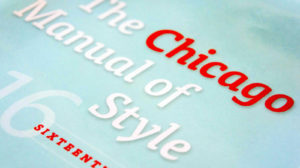
Styling Citations via Chicago Author-Date

Click to go to quick Chicago style guide

The ENVS style guide recommends that you cite references via Chicago author-date style; what does this mean? Many students learn only one method of citing references, but in fact there are literally thousands of citation styles! One handy method follows the Chicago Manual of Style, the definitive guide to writing and publishing in American English. There are two Chicago styles: A (notes/bibliography) and B (author-date). Notes/bibliography styles are common in the humanities (and some sciences), whereas author-date styles are more common in the social and natural sciences; for your online text purposes, author-date styles are easy to use and readable since no superscript is needed.

When you use an author-date style such as Chicago B, you include a parenthetical citation in the text, then a list of references at the bottom of your text (see some reminders below). So, how do you correctly format your citations, and list of references, in Chicago author-date style?

  1. The super-detailed way is to read the whole Chicago Manual author-date section (note that this and below links to CMS are to the on-campus version) and find the rules associated with your reference type; sometimes you need to do this with esoteric references, but usually you can follow one of the easier approaches below.
  2. Here is a handy guide with example citations and references in Chicago style (make sure to click the author-date tab!). This is often all you need. But there’s an even easier way to do it…read on.
  3. To create a correctly formatted list of references, just use Zotero’s built-in Chicago author-date citation style (Preferences > Export > Default Output Format; here’s help on downloading the style if you don’t have it). Then, each time you drag or copy a reference from Zotero, it will automatically format. (You can also specify Chicago author-date in Zotpress when inserting bibliographies onto a DS site page or post.) Note: if you follow this recommended method, make sure all reference metadata (e.g., author or date) are there, as you are still responsible for making sure your citation is complete.

And make sure you remember the basics of your citations and list of references:

  • Whenever you are writing about a publication, you need to cite it, typically right before punctuation such as a period, but sometimes in other places (see CMS 15.5 for an overview, and all sections 15.20 – 15.30 for details).
  • The citation is always (Author Date), never just (Author). If you have cited a quote, your citation will be (Author Date, Page[s]).
  • Your list of references should include all cited works, but no more (this is called “padding your bibliography”). If you’re doing your list of references manually it’s easy to forget one or two, so consider Zotero’s options to create your entire bibliography at once, or automatically insert citations and references (if using Microsoft Word).
  • The Chicago Manual (and your instructor) have specific guidance on what you do and don’t need to cite, and how often. Sometimes, repeated citations are unnecessary, and sometimes unpublished references are simply cited parenthetically or in a note and not included in the list of references.

Remember, one important mark of a good scholar is that they do citations correctly! Make sure you don’t detract from your excellent content by doing sloppy citations. And feel free to ask an ENVS professor for guidance as needed.

Recent ENVS Posts

Who is she?: Gaia and other Big Words
16th May 18By KT Kelly
Prioritization of Conservation: Intersections of the Peruvian Amazon and the Andean Mountain Range
8th May 18By Jon Hosch
Capstone 3
5th May 18By Alannah Balfour
Capstone #2
5th May 18By Alannah Balfour
Capstone #1
5th May 18By Alannah Balfour
Kokuritsukouen: The Past and Future of Japan’s National Parks
4th May 18By Rachel Aragaki
Investigating Climate Change: Understanding the Effects of Increasing Sea Surface Temperature (SST) on Arctic Fish Populations
3rd May 18By Marissa Weileder
Analyzing Anthropogenic Influence: A Look into How Humans Have Shaped the Perceptions of Climate Change
3rd May 18By Marissa Weileder
Freshwater & Fish: A Case Study of the Effects of Melting Permafrost on Arctic Freshwater Species
3rd May 18By Marissa Weileder
If You Die in the Game, You Die in Real Life: Video Game Environments and Disaster Preparedness
3rd May 18By Rachel Aragaki
Knickpoint Retreat and Stream Channel Morphology in the Columbia River Gorge
3rd May 18By Shawn Bolker
Barriers to Justice: Environmental Litigation in Hawaii
3rd May 18By Kassie Kometani
Satoyama Services: Historical versus Modern Roles of Japan’s Hybridized Landscapes
3rd May 18By Rachel Aragaki
Development Indicators for Fostering Development in Cambodia
3rd May 18By Nick Sievers
Building Flood Resilience in Urban Australia
3rd May 18By Curtis Hall
Choosing Direct Trade: Combating Vulnerability of Smallholding Coffee Farmers
3rd May 18By Evan Howell
Home-Based Water Recycling in Urban Australia
3rd May 18By Curtis Hall
The Sinking of Christchurch: Increased Flood Vulnerability after the 2011 Christchurch Earthquake
3rd May 18By Curtis Hall
Implications of a Growing Middle Class and Increased Consumption Patterns in India
3rd May 18By Nick Sievers
Alleviating Marginalization with Your Wallet: Investigating Fair Trade Coffee Consumer Behavior in Portland, Oregon
3rd May 18By Evan Howell
Religious Pilgrimage and Tourism on Mt. Fuji, Japan
3rd May 18By Shawn Bolker
Situating National Environmental Policies Within a Global Market (Proposal 3)
3rd May 18By Jonas Miller-Stockie
Using Trees to Alleviate the Coffee Crisis: Investigating Farmers’ Knowledge of Ecosystem Services in Veracruz, Mexico
3rd May 18By Evan Howell
Energy Security in South Korea: Methods of Reducing Foreign Fossil-Fuel Dependency
3rd May 18By Nick Sievers
Capstone Proposal #3: The Role Of Environmental Lobbying Firms Towards Progress In Environmental Policy In the U.S.
3rd May 18By Sabrina Cerquera
How the American People Conserve Energy: Can they Do Better?
3rd May 18By Jack Kamysz
Mediation of Climate Change in the U.S.
3rd May 18By Jack Kamysz
Assessing the Impacts of Waterfall Tourism in the Columbia River Gorge
3rd May 18By Shawn Bolker
Violence in Colombia: Illegal Gold Mining Leaves Indigenous Colombians at Risk
3rd May 18By Grace Boyd
The Interactions between hard and soft law in the Comprehensive Nuclear Test Ban Treaty
3rd May 18By Jack Kamysz

Recent Opportunity Posts

Eco Practicum Catskills – application deadline extension

Eco Practicum Catskills – application deadline extension

May 2, 2018

Actionable Climate Science Skills-Building Webinar Series

Actionable Climate Science Skills-Building Webinar Series

April 26, 2018

Lewis and Clark Summer Geospatial Project Assistant Student Position

Lewis and Clark Summer Geospatial Project Assistant Student Position

April 26, 2018

More Opportunity Posts

Digital Scholarship Multisite © 2018 · Lewis & Clark College · Environmental Studies Program · Log in